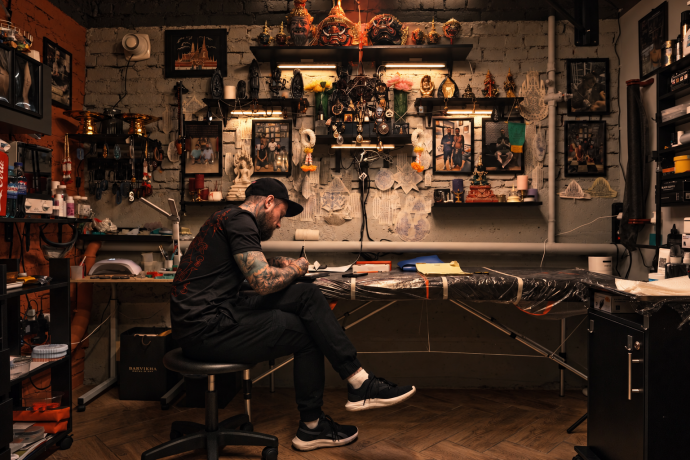
There are two approaches to choosing and preparing a Sak Yant: using a classic, established design, or creating an individual composition for a person’s request. Both are part of the practice I have learned and encountered through other masters. The choice belongs to the person receiving the tattoo.
My current lineage of training and practice is Khmer. My Sak Yant journey began with the Thai line, and I still work with many of its established designs. Over time, my practice is moving further towards the Khmer tradition I study in Cambodia.
Two Approaches to Sak Yant
Classic, Established Designs
The first approach is to choose from a collection of classic, standard designs. These are established yants that masters have applied for many years and that can be suitable for a broad range of people.
Within the practice described by the masters I learn from, repeated application and the large number of people carrying these yants are understood to contribute to their accumulated strength. Their continued use is part of their place in the tradition.
Choosing a classic design still involves a conversation about its meaning, size and placement. You can choose an original, authentic composition without asking for it to be redesigned.

A Design Prepared for Your Request
The second approach is to create a composition specifically for the person. It can be drawn freehand directly on the body or prepared in advance with a more detailed layout.
This composition is built from established forms and the principles used to construct them. These forms, their relationships and their methods of construction are often passed down within the lineage in which the master trains.
The individual work lies in how those foundations are brought together for your request, the placement and the space available on your body. The resulting composition remains connected to the knowledge transmitted through that training.
These two approaches reflect both my own experience and the practice of other masters. During the consultation, I explain the options so you can choose the approach you prefer.
Understanding Your Request
People come to Sak Yant for different reasons. Some are interested in protection, strength or support through a difficult period. Others feel a connection to a particular figure, form or tradition.
You do not need to arrive with a finished design or know the names of the formulas. You can explain your request in your own words.
We then discuss which approach suits you: choosing a classic yant or preparing an individual composition. We also consider whether you want a compact tattoo, a design built around a central figure, several connected elements, or an addition to an existing project.
My Training and Practice: The Khmer Line
My current lineage of training and practice is Khmer. Since 2022, I have been studying with the Sak Yant Federation in Siem Reap, Cambodia, returning each year to continue learning and deepen my practice.
The Thai line was the foundation of my Sak Yant journey. I still work with many Thai designs, mainly the established core repertoire. My work does not cover every branch or design within the Thai tradition.
Over time, my practice is moving further towards the Khmer tradition I study. This is a gradual development, shaped by what I learn, practise and receive through my teachers.
When discussing a design, I explain whether it belongs to the Khmer or Thai line. Its forms, formulas and meanings are considered within that tradition.
Both approaches—choosing a classic design or preparing an individual composition—remain connected to the relevant traditional foundations and methods of construction.
Formulas and Sacred Writing
The written elements are part of the structure of a yant. Their spelling, sequence and position require careful attention.
When preparing a design, I work with the formulas and study materials relevant to that composition. Where the text is in Pali, I consider both the wording and the script used to write it.
The consultation can therefore cover more than the appearance and general meaning of the tattoo. It can also include the formulas, abbreviated syllables and their role within the composition.
My source materials and guidance from my teacher inform this work, alongside my continuing study and practice.
Freehand Drawing and Advance Preparation
An individual composition can be drawn directly on the body. Working freehand allows the layout to develop in relation to the body’s shape and the surrounding tattoos.
It can also be prepared in advance. This allows more detailed work on the arrangement of figures, written sections and other elements before checking the composition on the body.
In either case, the design begins with the traditional forms and principles I have learned. The drawing method is one part of how the composition is prepared.
Size, Placement and Larger Projects
A design for the upper arm needs different proportions from a design for the back or chest. The amount of writing also affects the size needed to keep the details clear.
Before tattooing, we agree on the placement, scale and final layout. Designs containing Buddha images or revered teachers also require placement that respects the conventions of the tradition.
For an addition to an existing Sak Yant, I consider the whole project: what is already present, how the new elements relate to it, and how the composition may develop further.
Choosing Your Sak Yant in Moscow
I have worked as a tattoo artist since 2009. My Sak Yant practice combines that experience with ongoing training in Cambodia.
You can choose a classic, authentic yant that has been used by masters for many years, or an individual composition prepared for your request. Both approaches have a place in the practice.
We begin with a conversation about what you want, discuss the relevant designs and agree on the approach, size and placement before the work begins.