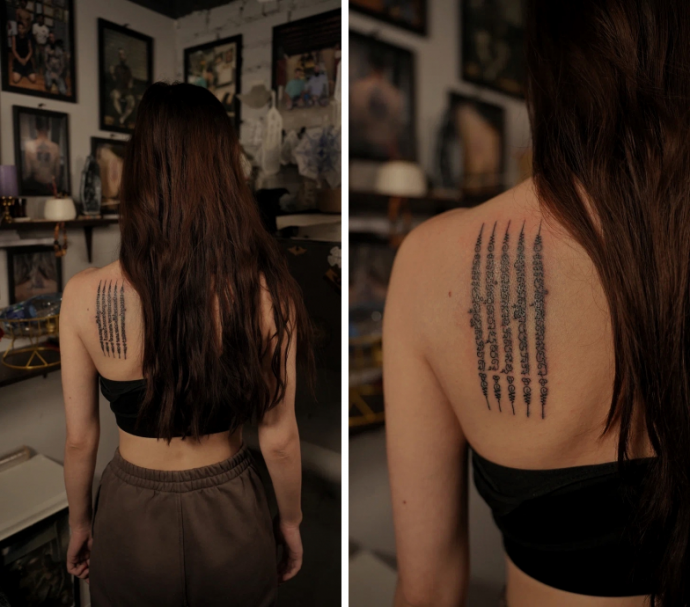
Five Lines, often called Hah Taew, is one of the most recognizable structures in modern Sak Yant.
Visually, it is built from five vertical lines. But the main mistake is to explain it as five completely separate meanings, where each line performs only one isolated task.
In practice, the structure works differently.
The meaning moves through the Five Lines as one connected sequence, where one task develops into the next.
Five Lines Belongs to the Thai Line
Five Lines is a structure of the Thai Sak Yant tradition.
It should not be confused with the Khmer Line and should not be presented as an old Khmer Yantra design.
This distinction is important.
Thai and Khmer traditions have many historical connections, including the use of related sacred texts, scripts and ritual practices, but their Yantra structures are not automatically interchangeable.
In my work I separate these traditions.
My main direction today is the Khmer Line, but Five Lines is one of the structures I work with specifically within the Thai tradition.
The Five Meanings Are Not Separate From Each Other
Five Lines is often described too literally.
For example:
first line — one meaning;
second line — another;
third line — protection;
fourth line — success;
fifth line — attraction.
This makes the structure look like five independent formulas placed next to each other.
A better way to understand it is as a continuous development of one task.
A basic Thai construction can move approximately through this sequence:
removing unfavorable conditions and obstacles → supporting the person's circumstances and direction → protection from negative influence → opening luck and successful development → strengthening Metta, charisma and positive attention.
Each stage prepares the next one.
The meaning therefore does not stop at the end of one line and begin again from zero in the next.
The whole Yantra works as one connected construction.
A Basic Thai Five Lines Structure
Removing Obstacles and Unfavorable Conditions
A basic version can begin with removing unfavorable circumstances and obstacles around the person.
This creates the foundation for the next task — supporting the person's direction, circumstances and ability to move out of a difficult or unsuccessful period.
Protection
After that, protection is added.
This can include protection from negative influence, harmful spiritual influence, magic and other factors that may interfere with the person.
Luck, Success and Development
Once the protective base is established, the structure can move toward luck, success and favorable development of new actions.
Metta and Personal Attraction
The final direction can strengthen Metta Maha Niyom — personal attraction, charisma, goodwill and positive attention from people around the wearer.
The important point is that these are not five isolated functions.
They are one developing sequence.
The Structure Can Be Adapted to the Client
Five Lines is not a rigid template that has to be repeated exactly the same way for every person.
The general form remains the same, but the master can adapt the internal task according to the client's request.
For one person, the main emphasis may be protection.
For another, it may be success, work, new opportunities or overcoming a difficult period.
Another person may need stronger Metta, confidence, charisma or positive attention from others.
This means the internal balance of the Five Lines can change.
But adaptation does not mean randomly changing symbols or inserting formulas only because they look good.
Every element still has to correspond to the task and work correctly inside the construction.
The Task Comes Before the Design
When I work with Five Lines, I do not start by choosing a picture.
I start with the person's request.
What exactly needs to be strengthened?
What needs to be removed?
Where is protection needed?
Is the main direction connected with success, personal confidence, communication, attraction or another task?
Only after this do I build the sequence.
For example:
remove obstacles → stabilize circumstances → establish protection → open favorable development → strengthen attraction and positive attention.
For another person, the sequence may have a different emphasis.
This is why two Five Lines tattoos can look similar externally but contain different internal work.
Why Copying a Ready-Made Five Lines Design Is Not Enough
A photograph shows only the external structure.
It does not explain what formulas were used inside it, what task the master set or why certain elements were included.
From the outside, two Five Lines designs may look almost identical.
Inside, they may be built differently.
For me, this is one of the main differences between simply reproducing a visual tattoo and actually working with a Sak Yant structure.
The design should follow the task.
The task should not be forced into a random ready-made design.
Five Lines and Individual Sak Yant Work
The Five Lines structure is useful because it allows several related tasks to be combined into one Yantra.
Protection can be connected with success.
Success can be connected with personal confidence.
Metta can be added as the final development of the work.
This makes Five Lines suitable for many individual requests.
But it does not mean that Five Lines is suitable for everyone.
Sometimes another Sak Yant structure is more appropriate.
The choice should always begin with the task, not with how famous or visually recognizable the design is.
Traditional and Machine Application
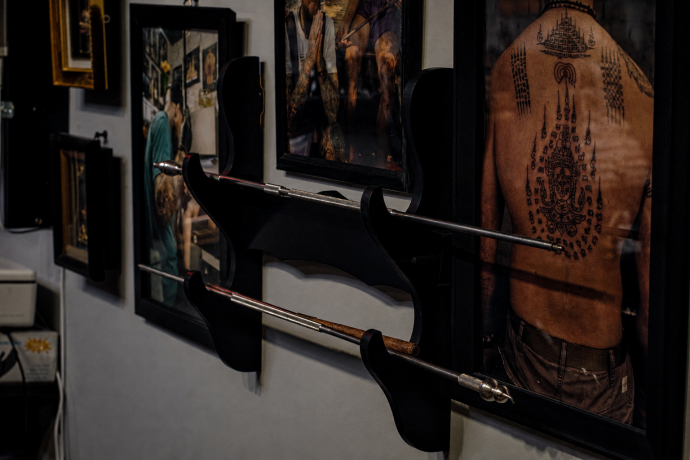
Five Lines can be applied using traditional hand-poked technique or with a tattoo machine.
The application method does not replace the structure itself.
For me, the important things are:
the correct construction;
the formulas used;
the logic of the task;
the relationship between all parts of the Yantra;
and the correct sequence of the work.
Technique is one part of the process, not the entire meaning of Sak Yant.
Five Lines Sak Yant in Moscow
In my Sak Yant practice in Moscow, I work with Five Lines specifically as part of the Thai Line.
Before preparing the design, we discuss the purpose of the Yantra and the task the client wants to solve.
If Five Lines fits that request, I build the structure around the individual task rather than simply copying a ready-made image.
The result should be understandable not only visually.
The person should know what the construction is intended to do and why these particular elements were used.
Final Thoughts
Five Lines is much more than five separate rows with five separate meanings.
It is a connected Sak Yant structure where one task develops into the next.
A basic Thai sequence may move from removing obstacles and supporting the person's circumstances into protection, success and finally Metta and personal attraction.
But the final construction can be adapted by the master according to the individual client and the specific purpose of the work.
And the main distinction should always remain clear:
Five Lines belongs to the Thai Sak Yant tradition. It is not an old Khmer Yantra structure and should not be mixed with the Khmer Line simply because both traditions are connected to Sak Yant.