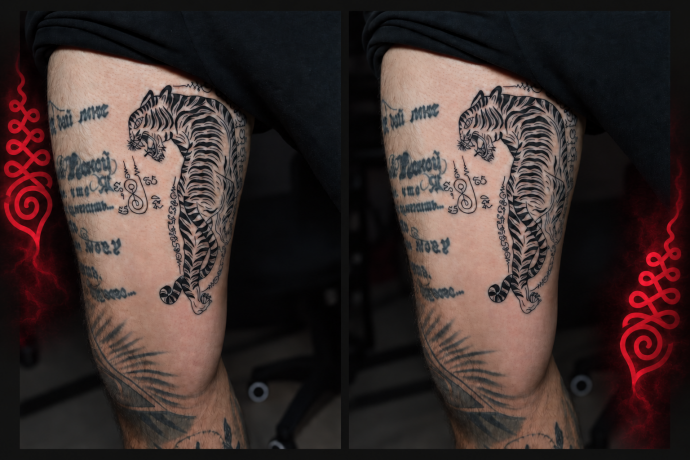
The Tiger is one of the most recognisable images in Sak Yant. It is usually associated with strength, courage, authority and the ability to protect oneself in difficult situations.
However, a Tiger Sak Yant is not simply a drawing of an animal with a general symbolic meaning. Its construction may include sacred formulas, individual Akara symbols and additional elements selected for a particular purpose. The exact structure and meaning depend on the tradition, lineage and knowledge of the master.
Tiger designs can be found in both Thai and Khmer traditions, but their visual form, internal content and method of construction are different.
One Tiger and Two Tigers Are Different Traditions
It is important not to combine these forms into one general design.
The Single Tiger in the Khmer Tradition
In the original Khmer tradition, the Tiger was represented as a single figure. This form carried its own structure, sacred content and protective purpose.
The single Tiger remains an independent protective figure. Its meaning comes not only from the animal image, but also from the formulas and Akara symbols placed inside and around it.
Two Tigers in the Thai Tradition
The well-known composition with two Tigers, usually called Suea Khu, belongs to the Thai tradition. It should not be presented as an original Khmer Sak Yant design.
Although both forms use the image of a Tiger, they come from different lineages and should be considered separately.

The Tiger Is More Than an Image
In Sak Yant, the Tiger cannot be understood only through its appearance. The animal itself represents strength, courage, authority and the ability to resist pressure, but the full purpose of the Yant depends on its internal construction.
Sacred formulas, Akara symbols and additional protective elements may be placed inside the body of the Tiger or around it. These elements determine the direction of the design and may strengthen protection, personal power, endurance, influence or confidence.
For this reason, two Tiger designs that look similar may carry different tasks. The visual image is only one part of the Yant. Its internal formulas and the tradition in which it was created are equally important.
Protection, Strength and Authority
The Tiger is primarily connected with protection, physical and inner strength, courage and the ability to defend one’s position. It may also represent authority, confidence and control over difficult circumstances.
These meanings should not be treated as a fixed list that applies to every Tiger Sak Yant. The final purpose depends on the tradition, the internal formulas and the task for which the design is created.
Different Tasks Within the Same Form
A Tiger may be constructed to strengthen protection, endurance and resistance to danger. In another design, the main direction may be personal authority, leadership or the ability to remain confident under pressure.
In the Thai Two Tigers form, the paired composition may also represent a balance between strength and control. In the original Khmer form, the single Tiger remains an independent protective figure with its own internal construction.
Therefore, the meaning comes not only from the animal itself, but from the complete structure of the Yant.
Traditional Structure and Individual Adaptation
A Tiger Sak Yant should not be assembled only for visual effect. Its form, direction, internal symbols and surrounding formulas must work as one complete structure.
The traditional base should remain recognisable, but the content may be adapted to the individual task. Protection, endurance, authority, confidence and personal strength can be combined differently depending on the person and their situation.
Adaptation Does Not Mean Free Modification
Adaptation does not mean freely changing the design or filling it with random symbols. Every added element must have a clear purpose and remain compatible with the main structure.
This is especially important when working with Thai and Khmer traditions. Their elements should not be mixed simply because they look similar. The lineage of the design must be understood before any changes are made.
Should the Tiger Be the First Sak Yant?
There is a traditional belief that a Tiger should not be chosen as a person’s first Sak Yant. It is considered a powerful and demanding protective form, and not everyone may be ready to carry it.
Today, this point is often ignored, and Tiger designs are frequently chosen only because of their appearance or general meaning.
In my own practice, I try not to make a Tiger the first Sak Yant. There are many details that should be considered: the person’s situation, character, purpose and the form of protection they actually need.
I am always happy to explain these nuances during a personal consultation before the final design is selected.
How I Work With a Tiger Sak Yant
The work begins with a consultation, not with selecting a picture. First, I need to understand why the person wants the Tiger and what task the Sak Yant should carry.
Consultation and Selection
We discuss the person’s situation, previous Sak Yant, the required form of protection and whether the Tiger is suitable at this stage. Only after that do I decide which tradition and structure can be used.
Choosing the Correct Tradition
If we work with the Thai Two Tigers form, it remains a Thai Line design. If we choose the original Khmer direction, the composition is built around a single Tiger. I do not combine these forms simply for visual effect.
Building the Complete Structure
The size, placement, internal formulas and additional elements are selected as parts of one complete construction. The goal is not just to make a recognisable Tiger image, but to create a balanced Sak Yant that corresponds to the person and the task.
Traditional Application of a Tiger Sak Yant
A Tiger Sak Yant can be applied by handpoke or with a tattoo machine. The tool itself does not determine whether the work is traditional.
What matters is the knowledge behind the design: the correct structure, the meaning of the internal formulas, the preparation of the Yant and the complete sequence of the work.
The design is prepared for a specific person and task. After application, the process is completed with the appropriate reading, charging and blessing of the Sak Yant.
For me, the main point is not to imitate the appearance of an old design, but to preserve its internal logic and purpose. Without this understanding, even a visually accurate Tiger remains only an ornamental tattoo.
Tiger Sak Yant in Moscow
I create individual Tiger Sak Yant designs in Moscow, working with both Khmer and Thai traditions while keeping their differences clear.
The process begins with a personal consultation. We discuss the purpose of the Yant, the person’s previous experience and whether the Tiger is the right form for the current task.
I do not use one standard design for everyone. The structure, formulas, size and placement are selected individually while preserving the traditional foundation of the chosen lineage.
Final Thoughts
The Tiger is one of the strongest and most demanding forms in Sak Yant. It is connected with protection, courage, endurance, authority and personal strength, but its meaning cannot be separated from its internal structure.
The original Khmer tradition used a single Tiger. The famous Two Tigers composition belongs to the Thai Line. These forms should not be mixed or presented as the same tradition.
There is also a traditional belief that the Tiger should not be the first Sak Yant. I take this point seriously and prefer to discuss every such project during a personal consultation before making the final decision.