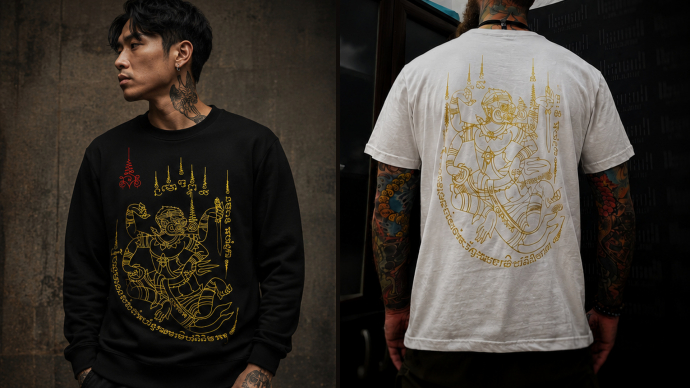
Hanuman is one of the most recognizable figures in Sak Yant. Many people first notice the movement and strength in his image. But a Hanuman tattoo cannot be understood from the picture alone. Its meaning depends on the particular design, its written elements and the tradition in which the master works.
What Does Hanuman Represent?
Hanuman is often associated with courage, strength, loyalty and protection. These are broad associations, not a fixed meaning for every Hanuman Yant. Different designs show him in different forms and may serve different purposes.
This is why I do not choose a Hanuman tattoo by asking a client to pick the most striking image from a collection of photos. First, we discuss what they want from the tattoo. Then I look at which form and construction are appropriate for that request.
Hanuman in the Thai Line
Hanuman appears in several forms within the Thai Line of Sak Yant. A change in pose, surrounding elements or written formula can change how a design is understood. Two tattoos that both depict Hanuman should not automatically be treated as the same Yant.
The figure may be the most visible part, but the complete design matters. When assessing a reference, I look at its structure and Akhara, not just the outline of the character. I do not add symbols or rewrite a formula simply to fill an empty space or make the tattoo look more dramatic.
Is Every Hanuman Sak Yant a Thai Design?
No. Hanuman also appears in Khmer material. The presence of Hanuman alone does not establish a tattoo’s lineage, just as the presence of Khom letters alone does not make a design Khmer.
Thai and Khmer traditions have their own forms and approaches. To identify a specific Yant, I need to examine the complete design and its source. I do not combine elements from different examples and present the result as an established traditional form.
Choosing a Hanuman Tattoo in Moscow
Before making a Hanuman Sak Yant, I discuss the client’s request, the available design and its placement on the body. Placement affects how the composition fits, but adapting a design to the body should preserve its essential structure.
Application technique is another choice we can discuss. I work with both traditional hand-poked and machine techniques. The tool alone does not determine whether a tattoo is Sak Yant; the design, its written elements and the way the work is approached matter too.
If you have a Hanuman reference, you can bring it to a consultation in Moscow. I will explain what can be identified in that particular design, what needs checking, and whether it fits your request. A photo can be a starting point for the conversation, but it is not a reliable explanation of the Yant by itself.