
Gao Yord, often translated as Nine Peaks, is one of the most recognizable Sak Yant forms. Its stepped construction and pointed upper section make it easy to identify, but the external shape is only one part of the design.
Inside the structure are sacred syllables, protective formulas and individual elements chosen for a specific purpose. For this reason, two Gao Yord tattoos may look similar from a distance while carrying different internal content.
What Is Gao Yord Sak Yant?
Gao Yord is a Sak Yant construction formed around a central geometric structure with nine upper peaks. The number and arrangement of these peaks create the recognizable outline of the design.
In some Thai lineages, Gao Yord is traditionally considered the first Yant a person should receive. This belief is connected with its placement: the design is positioned at the head of the other Yants and forms a protective foundation for the compositions added later.
Spire-shaped Yants are not limited to nine peaks. Depending on the lineage and the purpose of the design, they may contain from three to twenty-nine peaks. These variations can carry different protective tasks and internal formulas.
Gao Yord, or Nine Peaks, remains the most popular and recognizable form from this group.
However, Gao Yord should not be understood as a fixed image that must always contain the same text. Its structure provides a foundation, while the internal formulas can be adapted according to the person, the tradition and the purpose of the Yant.
In my work, I separate the external construction from its internal task. First, I determine what the person actually needs. Only after that do I select the appropriate formulas and build them into the design.
The Meaning of the Nine Peaks
The nine peaks form the upper part of the Yant and represent its main directional and protective structure. They create a complete composition rather than nine separate independent wishes.
The meaning of Gao Yord is usually connected with protection, stability, personal strength and support in difficult circumstances. Additional formulas may strengthen particular areas such as success, authority, confidence, protection from negative influence or the removal of obstacles.
This does not mean that every Gao Yord automatically provides the same result. The final task depends on what is placed inside the structure and how all its elements work together.
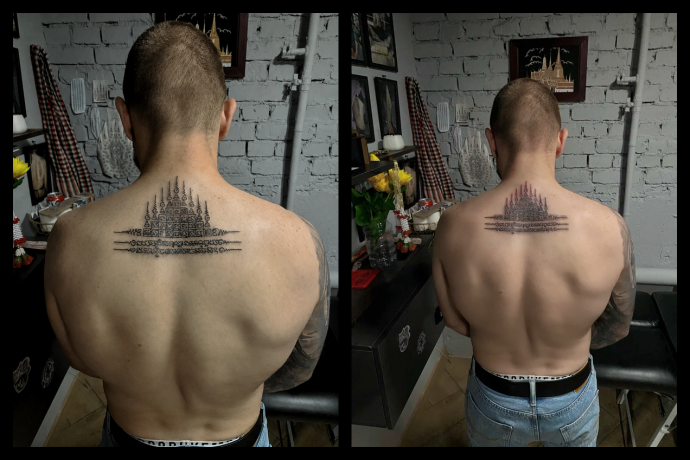
The Internal Structure of Gao Yord
The internal structure of Gao Yord is built in several connected levels. The lower part forms the foundation, the central section contains the main formulas, and the peaks complete the upper protective construction.
Depending on the lineage, the internal content may include combinations such as A San Vi Ta Pu Ka Ya Pa, Na Mo Bud Dhā Ya, Me A U and other sacred syllables. Their position, repetition and connection with additional symbols may differ.
It is therefore incorrect to identify Gao Yord only by the number of peaks. A copied outline without understanding its internal construction may look traditional but contain unrelated, incomplete or incorrectly arranged elements.
Gao Yord Is Not One Universal Design
There is no single Gao Yord template that must be used for every person. Different Thai lineages preserve their own methods of building the Yant, selecting formulas and arranging the internal elements.
The external form may remain recognizable, while the content changes according to the required task. One construction may focus mainly on general protection, while another may include additional support for personal strength, authority, success or overcoming obstacles.
This is why I do not simply copy a finished design from the internet. I first examine its origin and internal structure, and then decide whether it is suitable for the person and the task.
Protection as the Main Foundation
Protection remains the central foundation of Gao Yord. However, this is not limited to one narrow meaning.
The construction may combine protection from negative influence, support in difficult circumstances, stability, confidence and the strengthening of a person’s position. These tasks should work together as one connected system rather than as a random collection of separate wishes.
The final meaning of a Gao Yord tattoo is therefore determined not only by its nine peaks, but also by the formulas placed inside and the way the complete construction is built.
Gao Yord and the Thai Lineage
Gao Yord is most commonly associated with the Thai Sak Yant tradition. Although stepped and spire-shaped constructions can also be found in other regional traditions, they should not automatically be called Gao Yord.
A similar external shape does not mean that the design has the same origin, formulas or purpose. Thai and Khmer traditions may use different construction principles, scripts and methods of arranging sacred elements.
In my work, I keep these lineages separate. If I create a Gao Yord based on a Thai construction, I identify it as part of the Thai Line rather than presenting it as an old Khmer design.
Traditional Placement of Gao Yord
Gao Yord is most often placed high on the back, close to the base of the neck. In some Thai lineages, this position is important because the Yant remains above the other designs that may be added later.
It becomes the upper protective structure of the complete composition. This also explains the belief that Gao Yord should be received before other Yants.
However, placement must still be considered individually. The proportions of the body, existing tattoos and plans for future work all affect the final size and position of the design.
The Yant should follow the anatomy and remain visually balanced. It should not be reduced or stretched simply to fit into an unsuitable space.
Individual Adaptation of the Design
Individual adaptation does not mean changing the traditional structure without limits. The basic construction, direction of the formulas and relationship between the elements must remain clear.
Adaptation concerns the specific task, the selection of appropriate formulas, the proportions of the design and its connection with the person’s existing or future tattoos.
Before preparing the design, I discuss what the person expects from the Yant. Protection may remain the main foundation, but additional tasks can include stability, confidence, authority, success or support during a difficult period.
The final Gao Yord should remain a complete traditional construction rather than become a decorative collection of unrelated symbols.
Script and Sacred Formulas
The text inside Gao Yord is not a decorative imitation of ancient writing. The construction may contain Pali formulas written in Khom Akhara script together with specific sacred syllables and traditional symbolic elements.
The script, formula and meaning are different parts of the same design. A visually similar set of characters cannot be inserted simply because it fits the available space.
Before using any formula, I check its source, purpose and position within the construction. If the text cannot be confirmed, I do not add it to the Yant.
Hand-Poked and Machine Application
Gao Yord can be applied using the traditional hand-poked method or with a tattoo machine. The tool itself does not replace knowledge of the structure, formulas and purpose of the Yant.
The hand-poked method has its own rhythm and traditional character. Machine application allows the same construction to be created with controlled lines and clear details. In both cases, the internal elements and their correct arrangement remain the main priority.
I choose the application method together with the person, taking into account the size of the design, the condition of the skin, the placement and the desired visual result.
Preparing a Gao Yord Tattoo in Moscow
Before the session, we begin with a consultation. I need to understand the main task, check existing tattoos and decide how the new Yant will be positioned on the body.
After that, I prepare the construction and select the internal formulas. The design is checked before it is transferred to the skin. At this stage, proportions can be adjusted, but the sacred structure should not be randomly changed.
The session includes preparation, placement of the design, tattooing and the traditional opening and closing parts of the work. The exact process depends on the chosen method and the individual construction.
Final Thoughts
Gao Yord is much more than a popular Nine Peaks tattoo. It belongs to a wider group of spire-shaped Yants that may contain from three to twenty-nine peaks and perform different protective tasks.
Nine Peaks remains the best-known form, but its meaning cannot be determined by appearance alone. The lineage, internal formulas, position and relationship between all elements define the actual purpose of the Yant.
For me, the main task is to preserve the recognizable traditional foundation while creating a construction that corresponds to the person, the purpose and the complete composition.