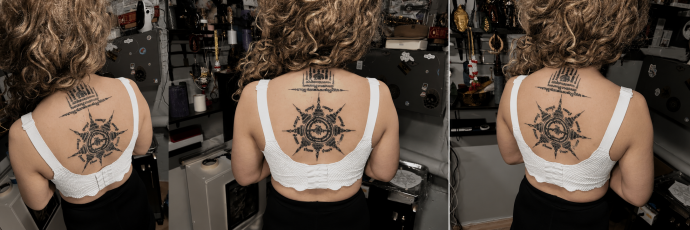
Paed Tidt belongs to the Thai Line of Sak Yant. Its name refers to the eight directions and to protection associated with the directions around a person. But that short description does not explain everything inside the yant.
When I prepare a Paed Tidt tattoo, I look at the whole construction: its geometry, the arrangement of the akkhara and the purpose of the particular version. I do not treat it as a decorative compass that can be freely filled with symbols.
What Do the Eight Directions Mean?
The central idea is protection wherever a person goes. For someone who travels often, that meaning may feel especially close. Yet I would not reduce Paed Tidt to a “travel tattoo”. A person’s request, the chosen form and the text within it all matter.
Designs called Paed Tidt can look different. Their details should not be mixed simply because they share the same name.
Structure Comes Before Decoration
One Thai Line form I work with uses a four-spire construction with sixteen akkhara arranged in four groups. The position of those groups is part of the design. Changing the letters or moving them only to make the tattoo look more symmetrical would change the construction I am working with.
I start with a verified form and then adapt its size and placement to the body. I do not invent extra signs to fill an empty space or copy details from an unrelated yant.
Why Size Matters
The finished tattoo needs enough space for its lines and letters to remain clear. Making a complex Paed Tidt too small can weaken the legibility of its construction.
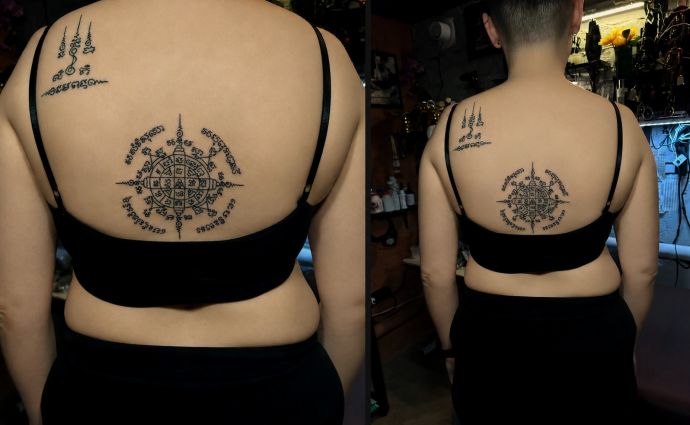
Choosing a Paed Tidt Tattoo
A consultation starts with the person’s request. We discuss why they are drawn to Paed Tidt, whether this particular form suits that request, and where it can sit properly on the body.
I also make clear that Paed Tidt is a Thai Line design. Thai and Khmer Sak Yant have their own forms and working approaches; I do not present them as one interchangeable tradition.
My Approach in Moscow
I prepare each Sak Yant as an individual piece. The drawing, its placement and the method of application are decided for the particular person. The traditional sequence of the work matters to me as much as the finished image.
Paed Tidt is a strong visual form, but I choose it for its construction and purpose first. If another yant fits a person’s request better, I will explain why during the consultation.