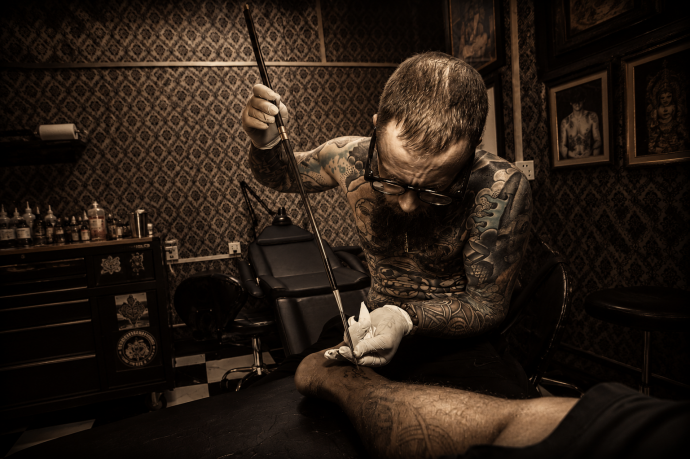
Mantras and Pali in Sak Yant: What to Know Before Getting Tattooed
Sak Yant is more than a design on the body. Within the tradition, it is not only the visual design, lines, symbols and placement on the body that matter, but also the textual component: the mantras, the script, the order of the characters and the meaning conveyed by the structure of the yant itself.
Many people see Sak Yant as a beautiful Thai or Khmer tattoo. That is an understandable approach. But if we look more deeply into the tradition, the design and the mantra work as a single system. The image establishes the form, direction and meaning, while the mantra complements it and connects it with a particular idea, quality or intention.
Why the Design Is Not the Only Thing That Matters in Sak Yant
Every classical Sak Yant has its own structure. It is not a random ornament or a collection of beautiful symbols. Within the tradition, the meanings of designs are passed from teachers to students through explanation, practice, copying, reading, tattooing and understanding how a yant is constructed.
The image may have its own meaning: protection, resilience, charisma, good fortune, strength, discipline, inner support, a path, purification or virtuous qualities. But mantras are often present alongside it. They are what make the design part of a traditional system rather than simply a visual pattern.
That is why, when choosing a Sak Yant, it is important to look beyond the picture. You need to understand exactly what is written within it, how it is written and whether the text corresponds to the design itself.
What Pali Is in the Sak Yant Tradition
Pali is a language closely associated with the Theravada Buddhist tradition. Many of the texts, formulas, invocations and mantras in Sak Yant are based on it.
It is important, however, to distinguish between language and script. Pali can be written using different writing systems. The Sak Yant tradition often features Thai writing, also called Akkhara Khom or Khom Pali. As a result, people sometimes confuse the mantra itself with the way it is written.
Put simply: Pali is the language of the text, while Akkhara Khom / Khom Pali is the Thai interpretation of the Khom script in which a mantra may be written in the Sak Yant tradition.
Na Mo Phut Tha Ya: One of the Best-Known Mantras in Sak Yant
One of the most frequently encountered formulas in Sak Yant is Na Mo Phut Tha Ya. It can be seen in many yantras, amulets, protective formulas, inscriptions on fabric, clothing and traditional objects.
This mantra is often known by different names: “the five blessings of the Buddha”, “the five holy Buddhas”, “the names of the five Buddhas” and other similar variations. Explanations may differ between schools and those who carry the tradition, but its overall meaning is often associated with protection, good intention, good fortune and spiritual support.
This is why many Sak Yants are popularly described as protective or as bringing good fortune. It is not only about the image itself, but also about the use of such kathas and mantras within many yants.
Why You Cannot Simply Copy Mantras from the Internet
One of the biggest mistakes is to take a Sak Yant design from the internet and simply transfer it to the body without understanding the text.
Visually, such a design may resemble a genuine yant. But there may be serious mistakes within it.
Missing Vowels
In the script used to write mantras, it is not only the main characters that matter, but also the additional elements. If an artist does not understand the writing system, they may omit vowels or important parts of the text.
As a result, the inscription still looks similar to a traditional one, but its meaning and reading are disrupted.
A Collection of Letters Instead of a Mantra
Sometimes an older tattoo contains nothing more than a collection of symbols rather than a mantra. Someone sees beautiful characters and assumes they form a traditional text, but reading them makes it clear that there is no structure, no meaning and no correct order.
Characters in the Wrong Order
Even if the individual characters look correct, their order matters. A mantra is not read as a decorative ornament. It has a sequence, a rhythm and a logic.
If the order is disrupted, the text no longer functions as a complete formula.
Abbreviations Without Understanding
Abbreviated forms may be used within the tradition, but an abbreviation must be deliberate and understood. When someone simply copies part of a text without understanding exactly what they have removed, the result is a mistake.
Why the Artist Must Understand the Structure of a Yant
An artist who works with Sak Yant must understand more than tattooing technique. It is important to understand the structure of the design: where the centre is, how the geometry is constructed, which symbols are used, how the text is read and why the elements are arranged in that particular way.
I have spent a considerable amount of time studying, deciphering and analysing the principles by which mantras are written for different Sak Yants. I read and write Thai, study the script used in the tradition and can distinguish an original design from an arbitrary copy.
That does not mean the journey is complete. On the contrary, the more deeply you study the tradition, the more clearly you understand how much more you need to practise and verify. But it is precisely this approach that helps you treat every design attentively rather than copying blindly.
What to Check Before Getting a Sak Yant
Before getting a Sak Yant tattoo, it is important to pay attention to several things.
Whether the Text Is Understood
It is not always necessary to obtain a word-for-word translation of every part. Within the tradition, some explanations cannot be conveyed to someone without preparation and an understanding of the Buddhist context. But the artist must understand exactly what they are tattooing, where the text comes from and how it is read.
Whether the Design Was Picked at Random from the Internet
The internet is full of beautiful pictures, but not all of them are connected with the tradition. Some designs have already been distorted, redrawn, cropped or assembled from different elements without any logic.
Whether the Mantra Corresponds to the Yant Itself
The text must be connected with the design. If the image conveys one thing but the mantra has been inserted at random, the composition loses its coherence.
Whether the Size Has Been Chosen Correctly
Making the tattoo too small can ruin the text. Some mantras cannot be reduced significantly, because the characters will become illegible and the structure will begin to break down.
Whether the Placement on the Body Is Appropriate
Placement matters in the Sak Yant tradition. Many classical yantras are placed above the waist: on the back, shoulders, chest, neck or arms. This is connected with cultural attitudes towards the body, symbols and sacred texts.
What to Do if an Older Sak Yant Was Done Incorrectly
If a Sak Yant has already been tattooed and contains mistakes, there are several possible approaches.
Sometimes individual parts can be carefully restored: the text can be corrected, the structure strengthened and the composition completed. But this is not always possible. Everything depends on how severely the original design has been disrupted.
In other cases, the old tattoo has to be covered with a new design. Sometimes part of the tattoo needs to be removed first, and the area can later be restored with the correct structure.
There is another approach: rather than correcting every old symbol individually, the design can be extended with new elements. This can create more accurate geometry, strengthen the composition and make the work visually coherent. But it requires careful analysis of the structure, symbols, mantras, placement on the body and condition of the old tattoo.
The more mistakes an older Sak Yant contains, the more difficult it is to correct. That is why it is better to check the design before it is tattooed rather than afterwards.
Faith, Practice and Personal Connection
In Sak Yant, it is not only the symbols and mantras that matter. Faith, intention and the connection between the artist and the person are important too.
I do not believe that an individual design necessarily has to be inferior to a classical one. Yes, many people who carry the tradition may say that a new design is a modern creation and will not work in the same way as the old yantras. There is a certain logic to this, because classical designs have passed through generations of practice.
But something else matters to me: if someone comes with an open heart, if there is trust between the artist and that person, and if the design is created with good intention, it can become far more powerful than an ordinary copy from the internet.
Sak Yant is about more than form. It concerns a person's inner state, discipline, respect for tradition and the energy they are prepared to invest in their path.
A Story About Na Mo Phut Tha Ya
There is a story about a master who told his student to make a large candle, stand on it and recite the mantra Na Mo Phut Tha Yawithout stopping. He told the student that if he could do this with complete faith, he would be able to fly.
In fact, the master did not do this with good intentions. He wanted to harm the student out of jealousy. But the student believed him, began repeating the mantra again and again and, according to the story, was able to rise into the air.
Of course, repeating a mantra does not make someone literally fly. The point of this story is not a miracle as a physical event. Its moral lies elsewhere: the power of faith, concentration and intention can change a person's inner state and give them inner support.
The same applies to Sak Yant. It is not only the tattoo that matters. The state of mind in which a person arrives, why they are doing it and how seriously they regard their chosen path all matter.
Why Information About Sak Yant Is Difficult to Find in Moscow
In Moscow, it is difficult to find truly useful, in-depth information about Sak Yant. What you most often encounter are general phrases about protection, good fortune, magic, strength and ancient symbols. But these often lack an explanation of exactly what is written, why a particular mantra is used, how the structure works and where the design comes from.
I am constantly learning myself. I use reliable sources, communicate with people who carry the tradition, study the script, texts and principles of yant construction, and continue to practise.
My goal is more than simply applying beautiful Thai or Khmer tattoos. It is important to me to understand the nuances and create designs that suit a particular person in their meaning, form, placement and inner needs.
Conclusion
Mantras and Pali in Sak Yant are an important part of the tradition that cannot be reduced to beautiful symbols. The same design may look similar but differ in quality depending on how the text is written, how well the structure has been preserved and whether the artist understands exactly what they are tattooing.
Before getting a tattoo, it is important to check both its appearance and the meaning behind the design. This is especially true of Sak Yant featuring mantras, Thai writing, Akkhara Khom, Khom Pali, traditional formulas and sacred symbols.
Sak Yant does not begin with a picture. It begins with understanding, respect for tradition and the right intention.