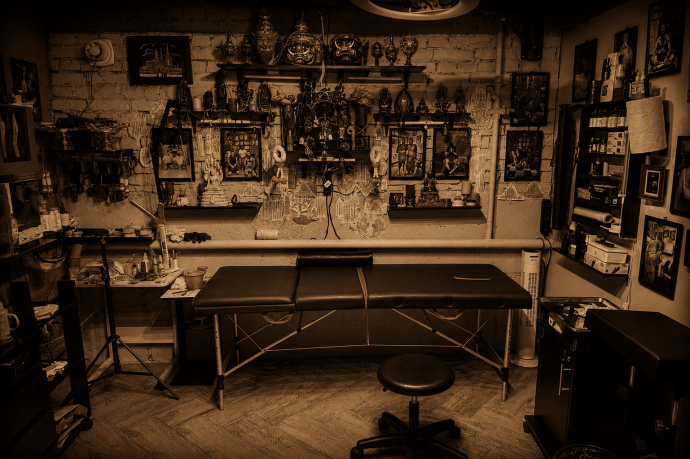
My Name Is Vyacheslav — a Sak Yant Artist from Moscow
My name is Vyacheslav. I am a professional tattoo artist from Moscow. I have worked in the tattoo industry since 2009. In 2014, I moved to Pattaya, Thailand, to work in a tattoo studio. That was where I became truly interested in Sak Yant tattoos.
I saw a great many people who flew to Thailand specifically to get a Sak Yant tattoo using the traditional method. That was when I began studying this culture in greater depth, observing the process and asking the artists questions.
Why Sak Yant Interested Me
I spent a great deal of time watching Sak Yant being applied. This did not happen only in dedicated places or temples. Very often, the work was carried out in ordinary tattoo studios and other spaces by different artists who were entrusted with applying this tattoo.
I asked about absolutely everything: why the symbols were applied in this particular way, how the techniques differed, what a particular yant meant, how the symbols were written correctly, who could read the ancient texts, and why some artists used certain elements while others did not.
My interest grew with every day, because there really is something sacred and magical about this tradition. And it does not matter exactly where this protective talisman is applied — in a temple, a studio or a private space.
During that time, I saw an enormous variety of artists, techniques, writing styles and approaches. I asked almost every artist questions.
My First Experience of Applying Sak Yant
The starting point was the moment when I first tried applying a Sak Yant tattoo to someone. Naturally, everything took place under the guidance of an experienced Sak Yant artist.
By then, I already had a general understanding of how the symbols were constructed and how individual elements were written correctly. In my view, this plays an enormous role, because the geometry, the rhythm of the lines and the structure of the yant itself are very important.
After that, I continued practising Sak Yant tattooing on my own. I continue this work in Moscow to this day.
A Technical Perspective on Sak Yant Tattoos
I looked at Sak Yant not only as a spiritual practice, but also from the perspective of the technical characteristics of tattoo equipment.
Thanks to my extensive experience in professional tattooing, I had a good understanding of the nuances of pigment depth, line consistency, the longevity of the work and how the skin behaves.
As a result, my early work was more precise, finer and neater in its execution. These tattoos stayed legible for longer and looked more consistent than tattoos applied traditionally with bamboo sticks.
At the same time, I have always respected the handpoke tradition itself, because it is more than a technique: it involves a particular atmosphere and a ritual within the process.
What Is a Sak Yant Tattoo?
In general terms, a Sak Yant tattoo is a magical, sacred tattoo with a spiritual foundation.
It is quite difficult to say exactly where this tradition originated. There are still many disputes between Thai and Cambodian people about the true origins of Sak Yant.
From my experience, I can say that the symbols, geometric elements, animals and birds have specific meanings passed down by elders and those who carry the tradition.
In the past, these yants were used as protective talismans in a wide variety of life situations.
Almost all the designs are accompanied by ancient mantras in Pali. These texts were later adapted into the ancient language of Khom Akkhara, which is now considered almost extinct.
Khom Akkhara and Ancient Mantras
Sak Yant can be found in different regions of Burma, Cambodia and Thailand. The texts may be written in different dialects, but Khom is considered the principal language.
It is best to learn the meaning of particular designs from those who carry the tradition, because Russian-language information about Sak Yant often turns out to be inaccurate or heavily distorted.
The names of mantras, such as Metta, Katta and many others, often do not in themselves give someone a full understanding of their essence. The texts of the mantras are directly connected with the Buddha and his teachings.
Only practitioners can deeply understand the meaning of these writings. They contain no specific references to wealth, possessions or prestige of the kind often claimed on the internet.
Sak Yant in Moscow — Contemporary Practice
Today, I continue practising Sak Yant in Moscow, combining the traditional approach with my professional experience in modern tattooing.
It is important to me to maintain respect for Sak Yant culture itself while creating work that is technically sound, neat and long-lasting.
I believe that a true Sak Yant artist should understand not only the visual aspect of a design, but also the origins of the symbols, the structure of the mantras and the particular features of the tradition.
How a Sak Yant Design Is Chosen
How is a design chosen? What is right for you personally? How can you understand the meaning of a yant and choose a symbol that suits your path in life?
I will discuss this in the next short articles on the blog about Sak Yant tattoos.
```