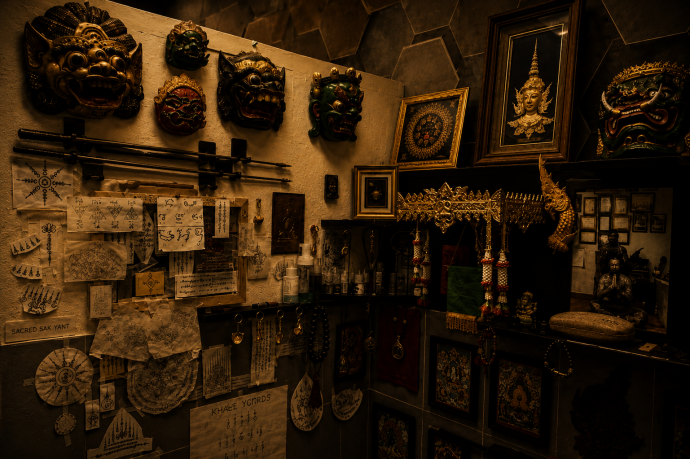
First of all, I personally find the word “Dhamma” the most accurate, although various spellings are used, including “Dharma,” “Dharma teachings,” and others. Here, the point is not to use the term simply as an appealing word, but to practice principles for living, mindfulness and inner discipline.
Sak Yant is often understood in different ways. For some, it is part of Thai or Khmer tradition; for others, it is a sacred tattoo with a deep meaning; and for others, it is a beautiful ornament with a cultural history. In any case, choosing such a design deserves careful consideration.
Why It Is Important to Choose Sak Yant Mindfully
Sak Yant is not simply a drawing that can be picked at random from the internet and transferred onto the body. Behind every traditional yantra is a system of symbols, a script, a composition, rules of placement and a connection to a particular school.
The tradition has been passed down through teachers, students, manuscripts, drawings and practice. The value of Sak Yant therefore lies not only in its appearance, but also in understanding exactly what is being tattooed, where it is placed and why it is chosen.
Sak Yant as Part of a Tradition, Rather Than a Random Pattern
Sometimes a person chooses Sak Yant expecting too much from it. They may feel that the tattoo itself should change their life, resolve inner difficulties or automatically bring about the desired result. However, this approach often leads to disappointment.
It is important to understand that Sak Yant can be a symbol, a reminder and part of a personal journey, but it does not replace a person’s actions, discipline and inner work.
Intention Matters More Than Expectations
One important aspect is a person’s intention. Sak Yant should not be a way of transferring responsibility to a symbol. It can offer support and a point of reference, but choosing such a design should be grounded in understanding rather than the expectation of quick changes.
If a person wants change but does not change their behavior, habits or attitude toward life, it is wrong to expect a result solely from a design on their body.
The Connection Between Sak Yant and Personal Responsibility
This is where the connection with Dhamma emerges. In its traditional sense, Dhamma is not a promise of an easy and flawless life. It is a path that helps us see what is happening more clearly, move through difficult periods more calmly and pay closer attention to our actions.
Dhamma Does Not Eliminate Difficulties
People sometimes mistakenly believe that following wholesome principles should automatically protect them from every problem. Yet life is not made up solely of pleasant events.
Buddhist tradition speaks of eight worldly conditions: praise and criticism, gain and loss, fame and disrepute, pleasure and pain. These conditions follow one another, and no one can completely exclude them from their life.
The Eight Worldly Conditions
These conditions show that life contains both pleasant and difficult periods. Practice helps us respond to change more calmly rather than avoid everything difficult.
Praise and Criticism
A person may encounter both approval and condemnation. It is important not to depend entirely on other people’s opinions.
Gain and Loss
All gains and losses are part of life. Mindfulness helps us avoid falling apart when things change.
Fame and Disrepute
External recognition is unstable. It should not become a person’s only source of support.
Pleasure and Pain
Pleasant and unpleasant experiences follow one another. Practice helps maintain inner balance.
How This Relates to Sak Yant
Sak Yant can be seen as a symbolic point of reference. It can remind a person of their chosen path, discipline, protection, resilience, respect for tradition and their own principles.
However, it is important to understand that Sak Yant is not a universal solution to every issue in life. It does not replace actions, honesty, effort, mindfulness and personal responsibility.
What to Consider Before Choosing Sak Yant
Choosing Sak Yant should be a calm and thoughtful process. It is important to consider not only its appearance, but also its meaning, placement on the body, tradition, composition and correct execution.
It is especially important not to copy random images from the internet without understanding their meaning, structure and connection to a particular tradition.
Sak Yant in Moscow
If you would like to get Sak Yant in Moscow, it is important to seek not just a beautiful sketch, but a knowledgeable explanation of the symbol, its meaning and its placement.
My task is to help you choose Sak Yant mindfully: without unnecessary mystification, random copies or a superficial approach to the tradition.
Sak Yant is more than a tattoo. It is a symbol that should be connected with understanding, respect and inner meaning.