
Sak Yant is often associated with monks, temples and Buddhist tradition. Online, you may encounter the view that authentic Sak Yant must be tattooed only by a monk. For someone discovering the tradition for the first time, this may sound convincing, but the reality is more complex.
This article is not an attempt to argue with anyone’s experience or prove who has the right to give Sak Yant tattoos and who does not. It is important to understand the distinction between monastic life, Buddhist rules, the transmission of knowledge and the practice of tattooing itself.
What the Sangha Is and Why Monks Have Rules
The Sangha is the monastic community. Following the formation of the Buddhist monastic tradition, a code of rules governing the lives of monks developed over time. These rules are known as the Vinaya, one of the divisions of the Pali Canon.
The Vinaya sets out monks’ discipline, conduct, restrictions and duties. Its purpose is to maintain a monastic way of life removed from worldly desires, personal gain and activities that might distract from spiritual practice.
Why Earning Money and Practising a Craft Matter
Restraint, discipline, studying texts, meditation, guidance and passing on the teachings to laypeople are central to the monastic tradition. This is why money, crafts, services and regular work on the bodies of laypeople require careful consideration.
Monastic rules are intended to prevent a monk from turning spiritual practice into a source of income or becoming absorbed in worldly occupations. This is precisely why tattooing by monks remains an ambiguous subject.
Why Tattooing by Monks Is an Ambiguous Subject
Sak Yant can indeed be found at temples and in association with monks. There are places in Thailand where monks take part in ceremonies, give blessings, recite texts or even tattoo yants. This practice exists, but it is important to understand that it conflicts with the monastic rules of the Vinaya, under which a monk’s life should be separate from crafts, earning money and worldly occupations.
Nor does this mean that every monk is automatically a Sak Yant artist. Monastic status may support knowledge of Pali, the reading of Buddhist texts and an understanding of the ritual aspects, but it does not in itself imply knowledge of tattooing, the construction of yants, traditional patterns, composition or the practical application of tattoos to the body.
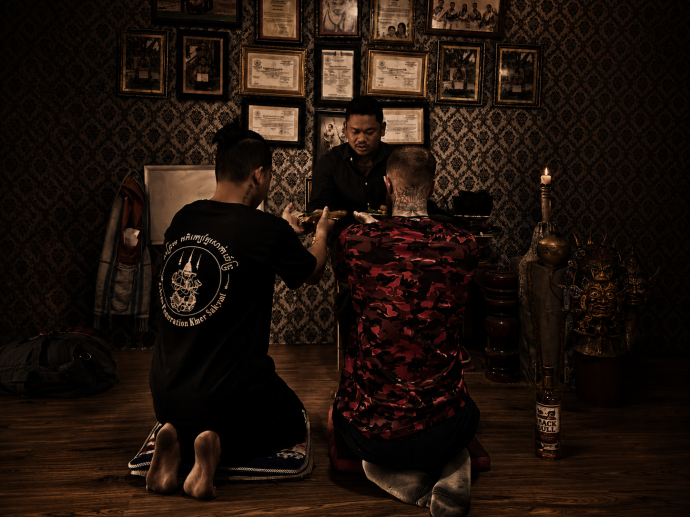
Monks and Sak Yant Artists: Different Roles
A monk may know Pali and read Buddhist texts, but Sak Yant is a distinct traditional practice. It requires a teacher, transmission, initiation, technique, an understanding of the yant’s structure, experience working with the body and an understanding of the tattoo itself as a system.
Sak Yant therefore cannot be judged solely by a person’s outward status. It is important to understand who trained them, the lineage in which they received their training, whether they can work with traditional patterns and whether they can explain the meaning of the work without fanciful stories or tourist myths.
Pali, Script and Sak Yant
Pali is the language of Buddhist texts in the Theravada tradition. Within the broader Sak Yant tradition, “Pali” is the term most often used when discussing the mantras, formulas and sacred texts associated with yants.
It is important to distinguish knowledge of Pali from the ability to create Sak Yant. A person may read Buddhist texts and understand individual formulas and ritual aspects, but that does not make them a tattoo artist.
What an Artist Needs to Understand
A Sak Yant artist needs several levels of preparation: an understanding of symbols, structure, the placement of text, traditional transmission, tattooing technique and how a yant should work on the body as a complete composition.
Mistakes in Sak Yant often arise when someone copies a yant’s outward appearance without understanding its structure. The result may be a collection of symbols lacking the proper logic, composition and transmission, rather than traditional work.
The Sak Yant Artist and Their Lineage
Monks are not the only people who play an important role in the Sak Yant tradition. Artists, teachers, ajarns and practitioners who have received knowledge through training and initiation are also important.
Such an artist may study Buddhist texts, train with a teacher, work with traditional patterns, follow the rules of their school and continue its lineage. They may be a layperson rather than a monk.
Why the Transmission of Knowledge Matters More Than Appearances
Sak Yant is not confined to a temple or monastic community. In different countries and schools, the tradition could be passed down through artists, families, teachers, warriors, practitioners and people specifically involved in tattooing, Pali script, patterns and the sacred structure of yants.
The central question, therefore, is not whether someone wears monastic robes. What matters more is whether they have a teacher, initiation, practical experience, an understanding of the tradition and a sense of responsibility for what they place on another person’s body.
Where to Get Sak Yant: From a Monk or an Artist
The choice always belongs to the individual. Some people want to receive Sak Yant in a temple, in the presence of a monk and within a ceremonial setting. For them, this may be an important personal experience.
Others choose an artist who tattoos professionally and understands composition, anatomy, sterility, tattooing technique and the traditional elements of Sak Yant.
What to Consider Before Choosing
The key is to look beyond outward appearances. It is important to consider who trained the artist, whether they understand the structure of a yant, can work with Pali script, follow safety practices, can explain the meaning of the work and avoid copying random pictures from the internet.
A Short List of Important Questions
- Has the artist received training within a lineage?
- Do they understand the structure of the yant, rather than just its outward design?
- Can they explain what will be tattooed?
- Do they follow sterile working practices and safety precautions?
- Do they work with the body as a composition, rather than simply transfer a picture?
Conclusion
Monks can indeed be part of the Sak Yant tradition. They may recite texts, give blessings and preserve part of the religious tradition. There are places in Thailand where monks also tattoo yants, but this practice remains controversial in relation to the monastic rules of the Vinaya.
The claim that authentic Sak Yant must be tattooed exclusively by a monk oversimplifies the subject. Monastic life and the practice of tattooing are different things.
For quality Sak Yant, transmission, a teacher, an understanding of the tradition, a sound structure, correct Pali script, tattooing technique and respect for the culture itself are all important. The choice should therefore be based on a person’s knowledge, training, experience and approach to the tradition, rather than their status.