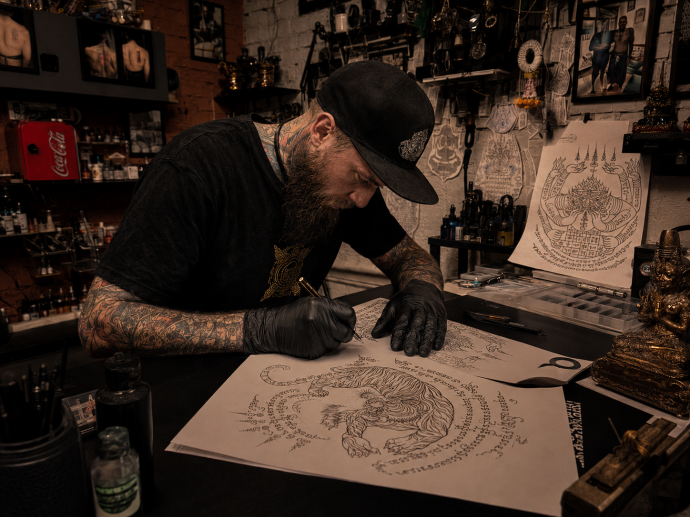
Sak Yant goes beyond the ornamentation of a tattoo. In Thai and Khmer traditions, these designs are built from symbols, yantras, mantras, geometric patterns, and figures, each with its own meaning and place in the composition.
Intricate figures such as Hanuman, Rahu, Ruesi, Ganesha, tigers, nagas, garudas, and other powerful symbols often attract the most attention. They may look like potent protective tattoos, but creating one takes more than choosing the picture. You need to consider its meaning, structure, placement on the body, tattooing technique, and how well the figure suits the person.
What Are Complex Sak Yant Protection Designs?
Complex Sak Yant protection designs usually take the form of full compositions centered on a powerful figure instead of small, isolated symbols. The figure may be a deity, a mythological character, an animal, a guardian spirit, a sage, or a creature from traditional symbolism.
These designs often include
- a central figure;
- Pali mantras;
- yantra elements;
- protective geometry;
- additional symbols;
- decorative elements and connections of meaning;
- adjustments to fit the body's anatomy.
Treating a complex protection design as an ordinary picture found online overlooks important details. Even if you recognize the figure, the proportions, the direction it faces, the symbols around it, and the overall meaning matter within the composition.
Why Complex Figures May Not Suit Everyone
Complex Sak Yant protection designs go beyond beautiful symbolism. These figures often carry powerful and layered meanings, so they may not suit every person.
Hanuman, Rahu, Ruesi, Ganesha, tigers, nagas, garudas, and other powerful figures call for careful consideration. In traditional understanding, the design on the body is a symbol connected to particular qualities, the person's state of mind, their character, and their direction in life.
Sometimes people choose a figure because it looks powerful, such as tigers, Hanuman with a weapon, Rahu, or fierce protective creatures. Appearance is only one part of the work. It matters what the figure represents and whether the person is prepared to live in keeping with it.
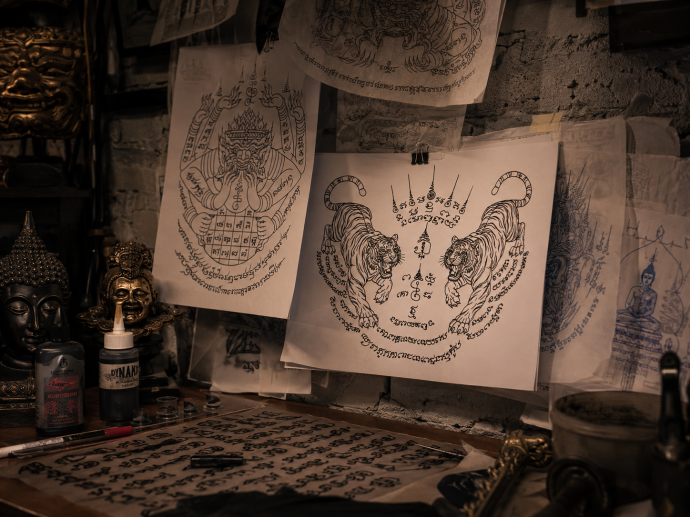
Tigers, particularly a pair of tigers, are a common example. A figure like this is best suited to someone with inner resolve, strength of character, or at least the beginnings of these qualities. The tiger symbolism can then seem to grow around the person, reinforcing what is already there and helping them develop confidence, willpower, and the ability to decide and act.
People who have yet to develop these qualities, or in whom the qualities are not strongly apparent, often ask for tigers too. There is nothing wrong with that, and it does not make anyone a lesser person. It simply means they may not have thought through the choice. They might not realize that the symbolism relates to a tougher inner stance, as though it calls for more strength, directness, decision-making, action, and responsibility from them.
A conversation about what the person wants and how well the symbol suits them is a better way to select an elaborate Sak Yant figure than choosing a picture they happen to like.
Why These Figures Are Considered Powerful
Hanuman, Rahu, Ruesi, Ganesha, and similar symbols often appear in traditional tattoos and amulets for a reason. These figures are associated with specific qualities such as protection, strength, discipline, overcoming obstacles, wisdom, resilience, transformation, and self-control.
Size or a fierce appearance alone do not make an image powerful. Its meaning comes from the combination of the figure, mantra, form, placement, and what the person is seeking.
A powerful Sak Yant figure should suit the person and the design as well as make an impression.
Hanuman in Sak Yant
Hanuman is one of the best-known and most popular figures in Sak Yant. He is often associated with strength, courage, devotion, vitality, protection, action, endurance, perseverance, and staying on course.
Hanuman also embodies more than strength and overcoming obstacles. Alongside his formidable qualities, the figure is full of charisma, appeal, liveliness, a love of life, and an affectionate nature. His warrior energy comes with a vivid personality, movement, charm, and the ability to draw attention.
Hanuman can be depicted in many ways, and each depiction changes how the symbol is perceived. He may be dancing, carrying a weapon, leaping, riding Singha, or appearing in a protective or combat form.
Each portrayal has its own character. Some emphasize movement and charisma, while others place greater weight on strength, protection, discipline, or a warrior's bearing.
Different Depictions of Hanuman
Dancing Hanuman
Dancing Hanuman can be seen as a more agile, lively, and charismatic figure. The image conveys movement, appeal, and lightness, and the ability to get through situations by force of personality as well as strength.
Hanuman With a Weapon
Hanuman with a weapon is a sterner, more martial portrayal. This composition emphasizes protection, action, readiness to fight, discipline, and the ability to stand by one's chosen course.
Leaping Hanuman
Leaping Hanuman is associated with movement, a sudden burst of energy, overcoming obstacles, and actively pursuing one's path. It conveys action, speed, courage, and an inner readiness to move forward.
Hanuman Riding Singha
Hanuman riding Singha is a more intricate composition that combines several powerful symbols. Its structure warrants particular care because the figure carries a greater concentration of meaning and needs a well-considered composition.
Hanuman therefore has many forms rather than a single universal depiction. Consider which form he takes, which symbols surround him, which mantra accompanies him, and how the complete composition sits on the body.
Rahu in Sak Yant
Rahu is a more complex and ambiguous figure. In traditional symbolism, he is often associated with shadow, change, trials, engulfing, protection from negative influences, and getting through difficult periods.
Rahu can be seen as a figure suspended between darkness and light. He embodies the idea of a threshold, of transition, of confronting difficult states and passing through them. That is why Rahu often looks powerful, dark, and tense.
In traditional understanding, Rahu can serve as a powerful protector from evil demons, negativity, oppressive influences, and anything that may surround someone during difficult periods of life. The figure carries strong themes of protection and transformation, giving it more weight than a simple decorative symbol.
For that reason, Rahu may not suit a first Sak Yant tattoo. The choice calls for care and an understanding of why the person wants this particular figure and whether they are ready for its symbolism.
Ruesi: A Figure of the Sage and Master
Ruesi, or Rishi, is the figure of a sage, hermit, teacher, and person devoted to knowledge and practice. In Sak Yant, the figure represents depth, discipline, learning, inner focus, and the transmission of knowledge, with no emphasis on aggression.
Ruesi can also be associated with mindfulness, the path to enlightenment, progress in spiritual practice, patience, inner work, and respect for tradition. The figure embodies the strength that comes through experience, practice, and understanding, a strength that works from within.
This symbol may resonate with people who value the path to mastery, learning, craftsmanship, spiritual discipline, concentration, and gradual development. Ruesi represents much more than an elderly man in a tattoo. In a well-built composition, the figure conveys mentorship, depth, and inner resolve.
Ganesha in Sacred Tattooing
Ganesha is a recognizable figure associated with overcoming obstacles, beginning a new path, wisdom, prosperity, and support in one's endeavors. People often choose him when they are going through a change, starting a new project, rethinking their life, or working toward a particular goal.
In Sak Yant and sacred tattooing, Ganesha can be depicted alone or as part of a more elaborate composition. The tattoo needs room to breathe. Ganesha is already a strong visual and symbolic focus, so the supporting elements should be arranged carefully around him.
Too many symbols without a clear relationship will make the composition heavy and hard to read.
Other Powerful Figures in Sak Yant
In addition to Hanuman, Rahu, Ruesi, and Ganesha, many other powerful symbols appear in Sak Yant. Each has its own character, visual structure, and meaning.
Tiger
The tiger is one of the most common and powerful figures in Sak Yant. It is associated with strength, authority, confidence, protection, drive, active energy, and the ability to hold one's ground.
A single tiger can stand for personal strength, character, and inner stability. Two tigers form a more powerful composition, intensifying the themes of protection, status, authority, confidence, and direct action.
The tiger is not a universal symbol. This figure calls for inner resolve, or at least the beginnings of a strength the symbol can help bring out. If someone chooses tigers only because they make a strong visual impression, but they are unprepared for difficult decisions, responsibility, and an active stance, the figure's meaning may weigh too heavily on them.
That does not rule out a tiger tattoo. It means the choice deserves a closer look. Sometimes a person really does need a tiger as a symbol of strength coming to the fore. At other times, it is better to begin with a gentler figure that is a more precise fit for where they are.
Naga
The naga is associated with depth, water, hidden strength, protection, and a mystical nature. The figure can take on a fluid shape that works well on elongated areas such as the arm, leg, side, and back.
In a composition, the naga tends to suggest deep, hidden, flowing energy rather than a sharp outward force. Placement matters so that the contours of the body do not break up the figure and the sense of movement is preserved.
Garuda
Garuda is a powerful figure associated with authority, lofty stature, protection, and rising above lower influences. Its complex shape, wings, movement, and many details require a well-built visual composition.
Give this symbol enough room. Garuda needs space, or the details will be lost and the figure will be difficult to read once the tattoo has healed.
Singha
Singha can be associated with noble strength, status, confidence, and protection. The figure often has a more formal, still appearance than Hanuman or a tiger.
Singha can likewise be portrayed in different ways and carry different meanings. In one composition it may have a more protective role, in another it may signify status, and in a third it may be part of a larger design with Hanuman, mantras, and additional symbols.
Yakshas and Protective Creatures
Some compositions feature protectors, guardians, and mythological creatures. This is a complex subject, so it is particularly important to understand an image's origins and meaning before using it.
These symbols can look powerful and fierce, but a fierce appearance alone does not make a sound protective composition. The figure's source, structure, placement, and relationship to the other elements all matter.
Why Appearance Alone Is Not Enough to Choose a Figure
A common mistake is to approach Sak Yant like an ordinary tattoo and say, “I like this picture and want the same one.” That approach works poorly for complex protective designs.
The same figure can be depicted in different ways, with different mantras, surrounding elements, and emphases. Hanuman can emphasize protection, combat readiness, charisma, or discipline. Rahu may represent transformation and protection during difficult times. Ruesi can embody wisdom, practice, knowledge, and mindfulness. Ganesha can express the start of a journey and overcoming obstacles.
Before deciding which figure to tattoo, consider why you want it, where it will sit, and how it will work within the overall composition.
Anatomy and Placement on the Body
Complex Sak Yant figures need the right placement. Certain areas of the body show off these compositions particularly well.
Areas often suitable for large figures include
- back;
- chest;
- shoulder;
- forearm;
- thigh;
- side of the torso;
- shoulder blade.
The back provides more room for symmetry and complex structure. The shoulder and arm suit figures with a sense of movement. The chest can give a centrally placed symbol more impact. The thigh can accommodate a large piece without distorting the design too much.
Consider how the tattoo will look in motion. A complex figure should stay intact when the body bends, keep its facial features, and remain free of distortions or loss of legibility caused by the wrong scale.
Machine and Traditional Techniques
Sak Yant can be done using a traditional technique or a tattoo machine. The tools are only part of the process. How the composition was prepared and how well the artist understands its structure matter too.
A tattoo machine can render details precisely, including lines, density, and intricate elements. That is especially important for large figures with faces, facial expressions, ornaments, mantras, and fine geometry.
Traditional technique gives the line a different character and uses a different process to apply it. Either way, the work depends on preparation, understanding the symbols, clean execution, and well-considered placement.
Designing a Custom Composition
Complex protective designs are best developed individually. Even when a traditional figure serves as the basis, it needs to be adapted to the person and to the specific area of the body.
Preparation takes into account
- what the person wants;
- the chosen figure;
- the size of the tattoo;
- the placement;
- the person's anatomy;
- any existing tattoos;
- the style of execution;
- the legibility of mantras and symbols;
- the possibility of extending the composition in the future.
Sometimes the best approach is to use a single powerful figure and leave open space around it. In other cases, the figure can be integrated into a more elaborate design of yantras, mantras, and supporting elements. The composition should feel coherent rather than look like a random collection of symbols.
Complex Protection Designs Can Work at Smaller Sizes
Many people think a powerful Sak Yant must be large. That is not always the case. Some symbols work well at a medium size if the placement is right and the design is not crowded with detail.
There is a limit to how small you can go with Hanuman, Rahu, Ruesi, Ganesha, and other intricate figures. Make them too small and you lose the details, the face, the lines, the mantras, and the overall effect.
Choose a size at which the tattoo will remain legible after healing, as well as immediately after it is applied.
Why the Artist's Experience Matters
Working with intricate Sak Yant figures takes more than good tattooing technique. The artist must know how the composition is built, which elements can be combined, where symmetry is needed, where decorative adaptation is acceptable, and where it is better to avoid improvisation.
Mantras and symbols need particular care. A visual mistake in a decorative tattoo may be a technical flaw. In Sak Yant, an error in the structure or text can change how the entire piece is perceived.
Discuss these tattoos in advance instead of simply asking for a copy of a picture.
How to Choose Your Figure
When choosing a complex protection design, it helps to start by asking what meaning the person is looking for and to consider pictures afterward.
For strength, action, and overcoming obstacles, consider Hanuman or a tiger.
If the person is going through a difficult period and wants a symbol of transformation, Rahu may appeal to them.
For knowledge, practice, the path to mastery, mindfulness, and discipline, consider Ruesi.
For a symbol of a new beginning, wisdom, and overcoming obstacles, Ganesha is a good fit.
For a more fluid and mystical image, consider a naga.
For a figure associated with authority, lofty stature, and protection, consider Garuda.
It is best to make the final decision after a consultation, once the placement, size, style, and overall intent are clear.
Conclusion
Complex protective Sak Yant designs are a distinct branch of sacred tattooing. Hanuman, Rahu, Ruesi, Ganesha, tigers, nagas, garudas, and other powerful figures call for a considered approach, because each has a structure of meaning that extends beyond its appearance.
A beautiful tattoo also needs well-considered placement, careful technical execution, and a coherent composition that fits the body.
What matters in Sak Yant is precision, suitability, and a clear understanding of why you chose that particular figure. Counting the symbols or making the figure look fierce misses the point.