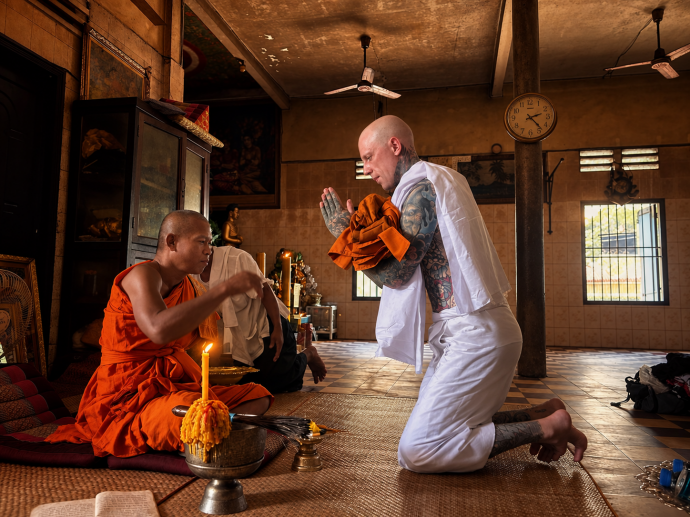
“An authentic Sak Yant must be done by a monk” is an impression people often get from articles and videos online. The temple, the monastic robes, the tattooing, and the recitation are seen as one process that a monk has to carry out.
So people specifically look for “Sak Yant by a monk,” even if they want to get a tattoo in Moscow instead of traveling to Thailand or Cambodia.
It helps to understand who applies the yant, who recites the texts, and what training goes into the work. I will explain this through my experience learning Sak Yant and undergoing novice ordination in Cambodia.
Does a Monk Have to Apply Sak Yant?
Sak Yant is connected with religious practice. Monastic status and proficiency in the art of applying yants are distinct.
The tradition also has lay practitioners who received knowledge from their teachers. A monk's involvement in the ritual does not always mean that the monk personally applies the tattoo. The monk may recite the texts and give a blessing, while a practitioner applies the tattoo.
Application, Recitation, and Blessing
It would also be wrong to say that monks never apply Sak Yant. The answer depends on the specific country, school, and practice. What happens at one temple does not describe the entire tradition.
Alongside “Is it done by a monk?” it is worth asking “Who exactly will apply my yant, who taught them, and what role does each person play in the ceremony?”
Why the Thai and Khmer Lineages Should Be Kept Distinct
Much of the popular Russian-language material about Sak Yant is associated with Thailand. The familiar image of a monk applying a sacred tattoo in a temple also comes from Thailand.
Thai practices cannot automatically be assumed to apply in Cambodia. Even within a single country, the way the work is done depends on the school and the teacher.
My Training in the Khmer Tradition
I work with both Thai and Khmer lineages, and the Khmer tradition is the main focus of my training. Since 2022, I have been studying at the Cambodian Sak Yant Federation in Siem Reap.
For each project it matters where the design and formulas come from. Yants that look alike may differ in content, recitation, and the teacher's interpretation. I therefore identify the lineage a project belongs to. A resemblance between designs alone does not justify carrying a meaning from one tradition over to another.
My Novice Ordination at Wat Svay
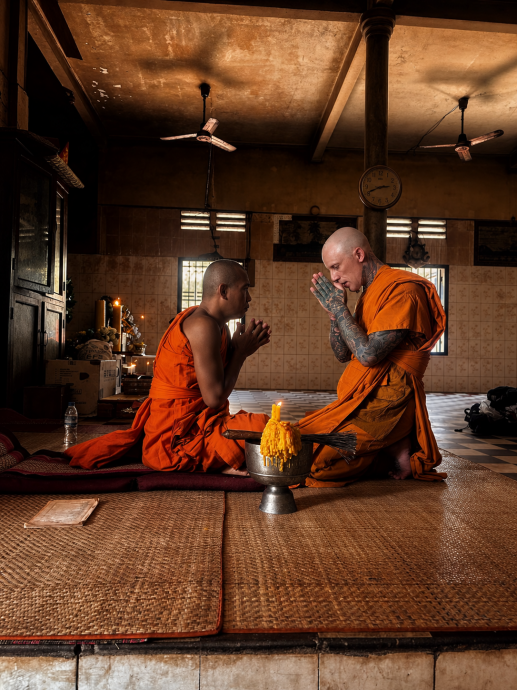
In 2026, at Wat Svay in Siem Reap, Cambodia, I underwent pabbajjā, ordination as a sāmaṇera or Buddhist novice.
The Pabbajjā Ceremony
The ceremony began in white clothing. I then asked for permission to receive the monastic robe, or cīvara. After changing into it, the ceremony continued.
This was ordination as a sāmaṇera. I did not undergo upasampadā, the full ordination as a bhikkhu. When my time as a novice ended, I returned to lay life.
I still visit the temple and help there. Photographs of the ordination are collected in the album of the ordination at Wat Svay.
Religious Experience and Sak Yant Training
This experience is part of my religious life. My training in the art of Sak Yant is separate. Pabbajjā does not take the place of knowledge of the script, the formulas, the composition, or the technique.
What Matters When Choosing a Sak Yant Practitioner
Monastic robes in a photograph may draw your attention, but they do not tell you how well the person is trained to work with yants.
What to Ask Before a Session
- Who trained the practitioner and which lineage they practice.
- Where the design and formulas for your piece come from.
- Which tradition the chosen yant belongs to.
- How the application, recitation, and blessing are carried out.
- Which tools are used and how they are kept sterile.
The Source of the Knowledge and How the Work Is Done
Some knowledge and formulas are kept private. The practitioner should still be able to explain where their practice comes from and how they work with you.
Quality of the Application and Hygiene
Look at completed tattoos as well. Assess the quality of the lines, the placement on the body, and the execution of the script. The religious aspect does not remove the need for quality and hygiene.
How I Work With Sak Yant in Moscow
I have been tattooing since 2009. I worked in Thailand for eight years and have continued training in Cambodia since 2022.
Discussing Your Request and Creating the Design
Work on a Sak Yant starts with a conversation. We talk about what you are looking for, the chosen tradition, the design, and its placement.
I work from material I study in my practice: examples of yants, texts, teachers' explanations, and verified sources. For a custom design, it is important to understand the role of every element. Formulas are chosen for their purpose, beyond filling space in the composition.
Application Technique and Recitation
I apply Sak Yant using both the traditional hand method and a machine. We discuss the most suitable approach before the session. I pay particular attention to the script, the placement on the body, and the recitation associated with the work.
In Moscow I practice as a tattoo artist who is still training in the tradition. My experience of novice ordination is part of my biography. I do not offer a tattoo applied by an active monk.
If You Are Looking for Sak Yant by a Monk
Think about what you want: to participate in a temple ceremony, to receive a monk's blessing, or to get Sak Yant from a practitioner of a particular lineage. These may be combined, or different people may take part in each.
If having the tattoo personally applied by an active monk is essential to you, ask about this in advance. Photographs of a temple or ceremony cannot guarantee that arrangement.
Consultations and Booking in Moscow
If you are considering Sak Yant in Moscow, you can see completed work on my site, read about my background, and view photographs of my pabbajjā at Wat Svay. At the consultation we will discuss what you want, a suitable design, and how the work will proceed.