Sak Yant Tattoos: The Khmer Tradition
The Origins of Sak Yant
The origins of Sak Yant reach back to the pre-Angkorian period (1st–6th centuries) in what is now Cambodia. Even then, Khmer tribes practised applying sacred designs to the body. These were more than decoration: people believed the images bestowed particular qualities on the wearer. The earliest tattoos included abstract symbols as well as realistic depictions of animals, birds, mythical creatures and demons. People believed that these images allowed them to take on the subjects' strength, agility, ferocity or wisdom—qualities needed in different areas of life, from hunting and warfare to emotional protection.
The Influence of Theravada Buddhism
When Theravada Buddhism arrived in the region (around the 5th century), ancient animist beliefs intertwined with the new philosophy. Pali, the sacred language of Buddhist texts, played a key role in the transformation of Sak Yant. Monks and masters (Kru) who knew Pali began incorporating abbreviated lines from sutras and protective formulas into the designs. Over time, these texts became short mantras (yant) woven into the graphic pattern. This gave rise to depictions of the faces of the Buddha and deities, as well as intricate geometric and rounded sacred forms—yantras whose every line and curve carried encoded meaning and energy.
How Knowledge Is Passed On
This heritage is passed orally from teacher to student after initiation. There were two main routes to receiving this knowledge.
The First Route
The first was directly from Teacher (Kru) to Student, when a master passed sacred mantras and the tattooing technique to a chosen follower.
The Second Route
The second was through ordination and service in a monastery. Monasteries offered the opportunity to study Pali in depth, understand the structure of the sutras and learn how to abbreviate them correctly into mantras. Knowledge of Pali is essential to creating a Sak Yant tattoo: without an understanding of what is written, the tattoo loses its power and becomes merely a picture.
The Modern Revival of the Tradition
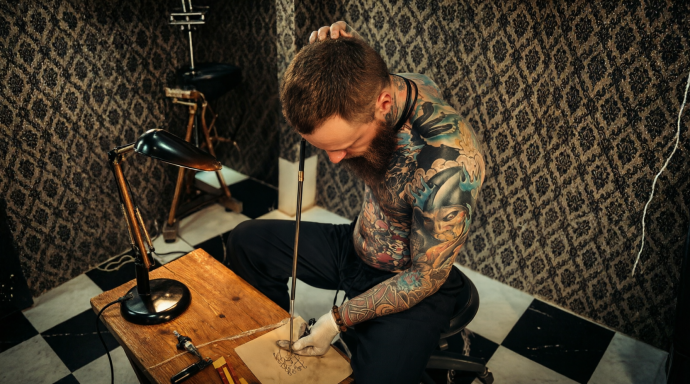
It was during this period that a unique synthesis emerged: the secret language of symbols, the ritual of tattooing with a bamboo stick and the ancient Pali language, all of which masters preserve to this day. This heritage has survived centuries, wars and changing eras, connecting the ancient warrior with the modern person seeking protection and harmony. Today Sak Yant is experiencing a revival, retaining its ancient roots while taking on more contemporary forms. Masters still use bamboo sticks, but the instruments have become sterile and the lines more even and precise. The ritual, mantras and Pali language remain unchanged. Yet this sacred art is now available beyond a select few: it reaches those who are ready for a deep understanding, rather than simply a beautiful design.
It is important to understand that Sak Yant is no panacea; it is a way of living and thinking. Its sacred aspect does not always work as a person would like, but with the right understanding it takes on great significance in each person's life. In my practice, many people who come to me achieve results and changes—not only because of the tattoo itself, but through following the way of life it implies.
The Artist's Personal Path
This text is based on personal experience. My path in Sak Yant began with many years of independent study of Pali writing and a variety of designs and forms, without a teacher or initiation, through books and meetings with masters and tattoo wearers while I lived and worked in Thailand. I gathered knowledge piece by piece, trying to understand the structure of mantras and the symbolism of the ornamentation. However, real understanding came only after I joined the Sak Yant Tattoo Federation (Cambodia, Siem Reap, 2023), where I continue my training and development to this day. Here I not only improved my stick-tattooing technique, quality and speed, but also gained knowledge of Pali: its original Khmer pronunciation and an understanding of the differences between Khmer and Thai writing.
Location and Studio
Moscow is currently my permanent base. I very rarely travel to other cities or countries for work, but I welcome anyone who wishes to travel to me. The only place I visit for work is the studio in Siem Reap, Cambodia, which has already become a second home. My Moscow studio is a space infused with the spirit of Southeast Asia: warm light, the scent of incense, a variety of deity figurines and the overall atmosphere of Asia. Every detail creates the feeling of a temple and a workshop at the same time.
My Approach to the Work
I approach my work with the utmost concentration and care. Every design is precise to the millimetre: ancient geometry does not allow approximation. I constantly practise and seek new depths, because Sak Yant is an endless path. Many different practices help me concentrate. I believe a Sak Yant tattoo is more than a tattoo; it is also a spiritual aspect of practices that must be developed continually. These two things are inseparable.
What Makes My Work Unique, and My Requirements
At present, I am the only artist in Russia working in the traditional Sak Yant style with sticks. I have no competitors in this field: I do not simply reproduce patterns, but read and understand Pali, giving every line the correct meaning and intention. Getting an appointment with me is not easy. I do not accept everyone—only those who are truly ready for the tattoo's sacred meaning, rather than simply wanting an exotic design. My work costs considerably more than ordinary tattoos, and there is a reason: it is backed by years of experience, regular trips to those who carry the tradition in Cambodia and Thailand, and practice with living masters. I have also received initial monastic ordination and spent time in a monastery as a monk. This gave me more than knowledge: it gave me an inner state that I convey through my work.