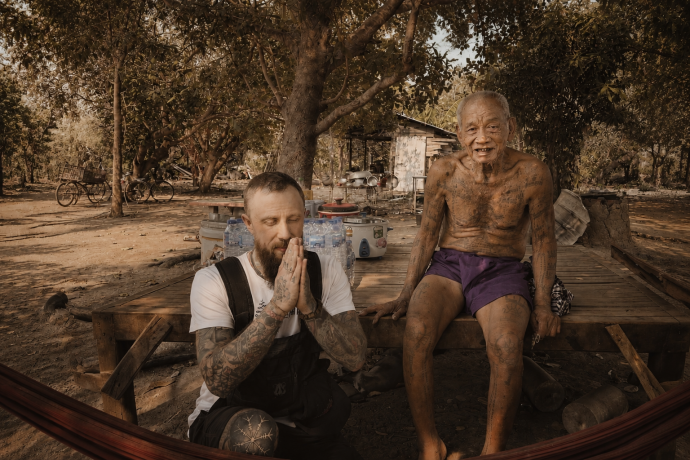
People interested in Sak Yant often ask: why do old traditional works look different from fresh photographs taken immediately after tattooing?
If you look at photographs of masters in Thailand and Cambodia, as well as surviving images of Sak Yant that are several decades old, you can notice an interesting feature. Many designs become softer over time, some lines appear wider, and individual elements take on a more natural appearance.
This is not a flaw in the work or a mistake by the master. On the contrary, such changes are a natural part of the life of any tattoo.
Every Tattoo Changes Over Time
Human skin is constantly renewing itself. Its condition is affected by age, lifestyle, tanning, physical activity, nutrition, and individual characteristics of the body. Even the highest-quality tattoo will look slightly different years later than it did on the day it was applied. Traditional Sak Yant is no exception. However, certain features make the aging process of such works somewhat different from that of many modern decorative tattoos.
Features of the Traditional Technique
In the Thai and Khmer traditions, many Sak Yant were historically applied by hand. The application technique, the depth of the work, and the character of the lines could differ significantly from modern machine methods.
As a result, the design was created from the outset with its appearance years later in mind. This is why many old traditional images have fairly generous spaces between lines and elements. This approach allows the composition to remain legible even after a long time.
Why Lines Appear Wider
One reason for the change in appearance is the natural behavior of pigment in the skin. After complete healing, pigment particles do not remain absolutely static. Over many years, the ink undergoes a slight natural redistribution within the tissues.
This is why very fine lines can become slightly wider. Traditional masters developed an understanding of this process long before modern dermatology emerged, based on many years of observing their own work.
The Influence of Placement on the Body
Different parts of the body age differently. For example, the skin on the back often preserves a design much more consistently than the skin on the abdomen or in areas where the tissues are constantly stretched. This is why many classic Sak Yant were traditionally placed on the upper back, shoulder blades, or shoulders.
Such placement is connected not only with tradition but also with the practical considerations of preserving the design over many years.
Why Old Sak Yant Look Softer
In fresh work, lines usually have their highest contrast. Over time, the skin goes through many renewal cycles. Under the influence of sunlight and natural age-related changes, the contrast gradually becomes softer.
This is why old traditional works often look more organic and natural than they did immediately after application. For many admirers of traditional Sak Yant, this transformation is part of the aesthetic.
Modern Work and Traditional Principles
Today, many masters use modern materials and equipment. However, when creating traditional compositions, it remains important to consider how the design will look years later.
For this reason, an experienced master assesses not only the appearance of a sketch on the day of tattooing but also its long-term prospects. The size of the elements, the spacing between lines, the placement on the body, and the characteristics of the client's skin have a major influence on the final result after 5, 10, or more years.
Conclusions
Authentic Sak Yant is more than a design on the day it is applied. It is work that continues to live with the person for many years. A thoughtful approach to composition, an understanding of how skin behaves, and respect for traditional principles therefore play a role no less important than the quality of the application itself.
It is precisely the ability to take the future condition of the work into account that distinguishes a thoughtfully designed traditional tattoo from a design created solely for a photograph immediately after the session ends.