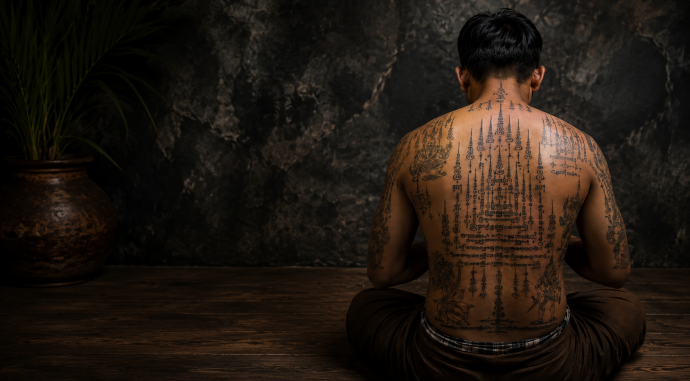
Why Sak Yant Tattoos Are Placed Above the Waist
One of the most common questions among people discovering the Sak Yant tradition concerns the placement of the design on the body. Many notice that most classic works are placed on the back, chest, shoulders, arms or upper body.
This raises the question: why is Sak Yant usually placed above the waist, and are there places where these designs should not be tattooed?
The answer is connected not only with tradition, but also with the culture of Southeast Asia, where the art of Sak Yant originated.
What Is Sak Yant?
Sak Yant is a distinct form of traditional tattooing that developed within Thai and Khmer traditions. Most designs are based on yantras, symbolic geometric forms, Pali texts, ancient mantric formulas and protective compositions.
Unlike an ordinary decorative tattoo, great importance is attached not only to the design itself, but also to its placement on a person’s body.
Why Most Sak Yant Designs Are Placed Above the Waist
In the traditional cultures of Thailand and Cambodia, the upper part of the body is regarded as a more revered area.
Particular importance is attached to the head, neck, shoulders and back. This is why many classic compositions were originally created for placement on the upper body.
The Most Common Locations for Sak Yant
- the upper back;
- the center of the back;
- between the shoulder blades;
- the shoulders;
- the chest;
- the forearms;
- the upper arms.
These are the locations most often used for well-known compositions from the Thai tradition, such as Gao Yord (Nine Spires), Hah Taew (Five Lines), Paed Tidt (Eight Directions of Protection), Sip Tidt (Ten Directions), various forms of Suea (Tiger), Hanuman, Garuda, and other traditional yantras and protective compositions.
The Khmer tradition also has its own arrangements of yantras, Pali texts and sacred symbols, with distinctive approaches to their structure and execution.
Can Sak Yant Be Placed Below the Waist?
There is no absolute prohibition. However, within traditional practice, many artists prefer not to place sacred symbols below the waist without a particular reason.
The reason is connected with respect for Pali texts, yantras and sacred symbolism. Large compositions are therefore more often placed on the back, chest and shoulders, where the design retains the correct orientation and follows the traditional approach.
At the same time, in contemporary practice, tattoos can be found on the legs, thighs and other parts of the body. This is particularly true of decorative interpretations or adapted designs.
Which Images Are Not Recommended Below the Waist?
It is worth noting separately that traditional practice discourages placing images associated with the Buddha, various enlightened beings, Rusi hermits and other highly revered spiritual figures below the waist.
This is connected less with a prohibition in itself than with the respectful treatment of these images in the cultures of Southeast Asian countries.
This is why such compositions are most often placed on the upper body: on the back, chest, shoulders or arms. This approach is found in both Thai and Khmer traditions.
Where Should Sak Yant Not Be Tattooed?
This is one of the most popular questions among people who are just beginning to explore the subject.
In practice, there is no universal list of prohibited locations. Different artists hold different views. Some work exclusively within traditional placement schemes, while others allow a more flexible approach.
Most restrictions concern particular symbols and texts, for which certain areas have traditionally been recommended, rather than a specific part of the body.
The question is therefore usually addressed individually during a consultation.
Why Sak Yant on the Back Is Considered a Classic Choice
The back has been the most popular location for Sak Yant for many generations.
Enough Space for Complex Compositions
Many traditional yantras contain numerous lines, Pali texts and small elements. The back allows the design to retain its legibility and detail.
The Possibility of Developing the Work Further
Many compositions can be expanded over time with new elements. It is easier to build a harmonious arrangement of several works on the back.
Preserving Proportions
Historically, most classic designs were created specifically for vertical placement on a person’s back.
Are There Strict Rules for Sak Yant?
Many myths surround the subject. Claims are often made about a supposedly single set of mandatory rules for everyone who wears Sak Yant.
In practice, the situation is considerably more complex. Traditions can differ according to the school, region, artist and approach.
There are recommendations concerning the placement of symbols, respect for the images and an understanding of their meaning. However, there is no single set of rules that applies equally to every artist and every tradition.
How to Choose a Location for Sak Yant
The choice of location depends on several factors:
- the size of the composition;
- the amount of detail;
- plans to develop the work further;
- the person’s anatomy;
- the chosen symbol;
- the traditional placement of the particular design.
An experienced artist therefore usually considers not only the design itself, but also how it will look on the body in several years and how it may fit with other elements.
Conclusion
The reason most Sak Yant designs are placed above the waist is primarily connected with tradition, the cultural characteristics of Thailand and Cambodia, and historically established placement schemes.
There is nevertheless no absolute prohibition on other areas of the body. It is important to understand the characteristics of the chosen symbol, take the artist’s recommendations into account and plan the overall composition of the future work in advance.