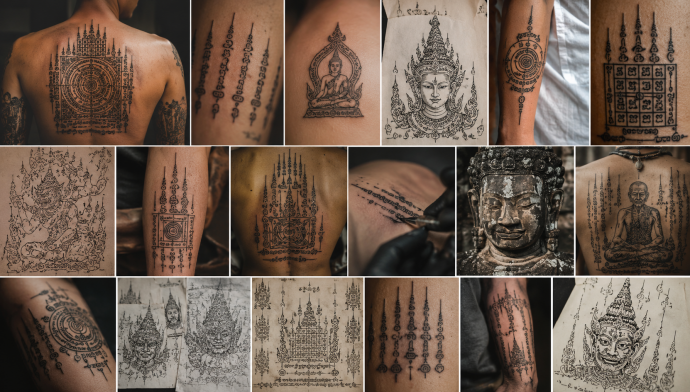
Genuine Sak Yant and the Problem of Fake Sak Yant
In recent years, Sak Yant tattoos have become popular far beyond Thailand and Cambodia. Thousands of images, designs and “magical yants” circulate on Pinterest, Instagram and TikTok. The problem, however, is that a large proportion of these images have no connection with the genuine tradition.
In many cases, they are not Sak Yant in the traditional sense, but merely a visual imitation of Southeast Asian style — so-called art inspired by sacred graphics.
Many images contain:
- random symbols,
- mistakes in mantras,
- upside-down texts,
- non-existent yants,
- elements mixed from different traditions,
- and completely invented “magical” signs.
A person gets the tattoo believing it to be an ancient protective symbol, but actually receives decorative graphics without a correct translation or an understanding of the meaning.
What Genuine Sak Yant Is
Sak Yant Is More Than a Pattern
Genuine Sak Yant is a sacred system of symbols, mantras and geometry that comes from the Buddhist and animist traditions of Southeast Asia.
Every yant has:
- a particular structure,
- a correct composition,
- a sacred meaning,
- a mantra,
- and traditional rules for its application.
Within the original tradition, the master understands:
- the translation of the text,
- the meaning of the mantra,
- the origin of the yant,
- and its purpose.
This is precisely why genuine Sak Yant cannot be compared with an ordinary decorative tattoo.
Why There Are So Many Incorrect Sak Yant Designs Online
Mass Copying of Designs
Most popular Sak Yant images on the internet have been copied from one another for years. Often, the original drawing already contains mistakes, and repeated redrawing distorts the symbols even further.
This results in:
- missing elements,
- broken geometry,
- mirrored images,
- extra symbols,
- and incorrect mantras.
Translation and Mantra Errors
One of the main problems is the incorrect translation of Sak Yant.
Many people search for:
- “Sak Yant translation”,
- “yant meaning”,
- “mantra translation”,
but encounter information whose authors do not themselves understand what is written in the yant.
Sometimes a tattoo contains:
- mixed-up syllables,
- missing parts of the mantra,
- random symbols,
- or text that cannot be read at all.
Mixing Traditions and Symbols
Today, it is common to find designs in which:
- Buddhist yants are mixed with Hindu symbols,
- Thai elements are combined with Balinese ones,
- and modern decorative ornaments are added on top.
It is also common to see:
- faces of Buddhas,
- elders,
- Ruesi,
- and many other images that do not belong to traditional Sak Yant.
From the perspective of the tradition, such work is a stylisation or an art project rather than a genuine sacred yant.
The Main Sak Yant Mistakes
Copying Without Understanding
The most common mistake is choosing a tattoo solely because the picture looks beautiful.
Sak Yant is a system of symbols and texts in which it is important to understand:
- the meaning,
- the origin,
- the translation,
- and the purpose of the yant.
Incorrect Placement on the Body
There are certain restrictions within the tradition.
Some images and sacred elements:
- must not be placed below the waist,
- must not be turned upside down,
- must not be combined with one another,
- while some mantras require a particular placement on the body.
This applies especially to:
- faces of the Buddha,
- images of elders,
- sacred texts,
- and religious symbolism.
But completely chaotic compositions, created without an understanding of the tradition, are common online.
Fake Sak Yant and the Problem with Contemporary Artists
Knowledge of Pali and the Script
One of the most important points concerns artists who are not themselves bearers of the tradition, since many tradition-bearers do know the basics of Pali.
This primarily concerns other artists who create Sak Yant tattoos without studying:
- the Pali language,
- the script,
- traditional mantras,
- and the system of yants itself.
It is precisely knowledge of Pali and the script that makes it possible to understand:
- whether an artist creates individual work,
- or simply copies ready-made designs from the internet.
It really is easy to find a “meaning” for a ready-made image. But most often, this is superficial information without an understanding of exactly what is written in the text or how it should look in its original form.
How to Distinguish Genuine Sak Yant from a Fake
Pay Attention to the Details
Genuine Sak Yant usually has:
- a clear structure,
- correct symmetry,
- a coherent composition,
- correct mantras,
- and traditional geometry.
Fake yants often look like:
- a chaotic collection of symbols,
- decorative graphics,
- or a “magical” design with no translation or meaning.
An important point: this is not directed at masters who carry the tradition, since many of them do know the basics of Pali. The problem more often arises with artists who use the Sak Yant style purely as a visual aesthetic, without understanding the language, the mantras or the structure of the yants themselves.
Why You Cannot Simply Download a Design from Pinterest
Most Popular Designs Contain Mistakes
Many “Sak Yant designs” from Pinterest and Google:
- have been redrawn dozens of times,
- have missing elements,
- contain mistakes in the symbols,
- and are far removed from the original traditional forms.
Some images are created entirely by designers or AI systems with no connection to the Sak Yant tradition.
Conclusion
Genuine Sak Yant is more than a beautiful ornament. It is a system of sacred symbols, texts and mantras in which every line and the meaning of every element matter.
That is why, before getting tattooed, it is important to:
- understand the translation,
- check the meaning of the yant,
- study the origins of the symbols,
- and choose an artist familiar with the tradition and the Pali language.
This is precisely why there are so many incorrect and fake Sak Yants today that look impressive but have no connection with the genuine Sak Yant tradition.