As Sak Yant has grown in popularity around the world, the number of mistakes in such work has also increased. Today, you can find thousands of images that outwardly resemble traditional yants but, on closer inspection, turn out to be incorrect, incomplete, or entirely unrelated to the tradition.
For someone encountering this subject for the first time, telling a well-executed Sak Yant from a flawed one can be difficult. This is especially true if the design looks beautiful and has been applied neatly from a technical standpoint.
Let us look at the most common mistakes found in Sak Yant.
Mistake No. 1. Copying an Image Without Understanding Its Content
One of the most common situations is that someone finds a photograph they like online and asks for the design to be reproduced.
The problem is that a vast number of images online already contain mistakes. Some have been redrawn incorrectly several times in succession, completely losing the original structure of the symbols.
Loss of the Yant's Structure
The problem goes beyond the loss of individual elements. Over time, the logic behind the image's construction, the order of the symbols, and the very structure of the yant can disappear entirely.
The Master's Handwriting and Individual Execution
In addition, many modern images clearly show the same handwriting, as though they were made using the same stencil. This is rare in the tradition. Even when two people receive the same yant, most masters execute it individually, preserving their own style of writing the symbols and elements of the composition.
Over time, each master develops a distinctive handwriting that can be recognized across different works. In my practice, for example, each person gets an individual design. Even if the same yant suits someone else, I create it again from scratch instead of copying an earlier work.
As a result, the person receives a copy of a copy that visually resembles a yant but no longer matches the original image.
Mistake No. 2. Incorrect Symbols and Letters
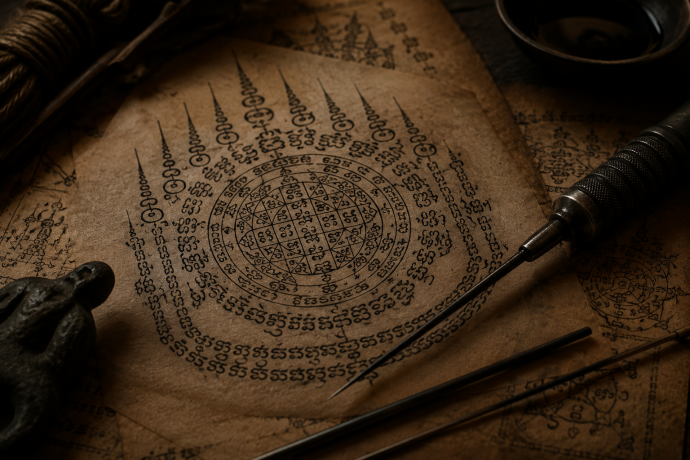
There is a widespread myth that if a design contains Thai letters, it automatically qualifies as Sak Yant.
In practice, it is much more complicated.
Pali as the Basis of Traditional Texts
The basis of most traditional texts in yants is Pali, the language in which ancient Buddhist texts and many sacred formulas were recorded and have reached us through the Thai and Khmer traditions.
The texts themselves, however, may be written in various writing systems, including Thai and Khmer scripts.
Why Mistakes Are Hard to Spot
This is precisely why someone who cannot read Pali is often simply unable to spot errors in the text. The symbols may look convincing, yet instead of ancient formulas, they may contain modern words, random phrases, or sets of symbols unrelated to traditional mantras.
Many decorative images are created in exactly this way. They use individual Thai or Khmer letters that visually resemble Sak Yant but do not actually carry the content traditionally conveyed by these texts.
Mistake No. 3. Trying to Get a Translation From a Photograph
Many people with Sak Yant ask:
“Can you translate my yant from a photograph?”
Unfortunately, this is far from always possible.
Why Sak Yant Cannot Always Be Translated Literally
Most traditional yants are not ordinary texts that can be translated word for word. The composition uses abbreviations, special notations, symbolic markings, and elements that require an understanding of the specific design and its structure.
Acronyms and Abbreviations in the Thai Tradition
In the Thai tradition, such abbreviations are often called acronyms: shortened forms of notation based on the initial letters or key words of the main text. Without knowledge of these principles, an accurate translation and an understanding of the image's meaning become extremely difficult.
Abbreviated Mantras and Repositioned Symbols
The ways traditional texts are written create additional difficulties. Yants often contain abbreviated mantras, parts of the text moved to other positions, shortened versions of formulas, and other elements understood only by someone familiar with the tradition.
Sometimes an individual symbol may be missing simply because it could not physically fit in a particular part of the composition. Without an understanding of the context, such features can easily be mistaken for errors, even though they are actually part of the traditional notation.
That is why a search for “Sak Yant translation” often turns out to be much more complicated than it first appears.
Mistake No. 4. Combining Different Yants in One Composition
Sometimes people put together a sketch themselves using several images.
What This Usually Looks Like
- the upper part from one yant;
- the central part from another;
- the lower symbols from a third.
From a design perspective, such a composition may look harmonious, but in terms of traditional construction, it raises many questions.
Why the Integrity of the Image Is Disrupted
Every yant has its own structure and logic for the placement of its elements. When different images are combined at random, the resulting work often loses its integrity.
Mistake No. 5. Using Random Symbols as Decoration
In recent years, dozens of decorative sketches have appeared, created solely for their appearance.
What Is Often Found in Such Works
- random letters;
- upside-down symbols;
- mirrored elements;
- invented signs.
To most people, they look like traditional Sak Yant, even though they are actually stylized designs.
There is nothing wrong with this if the person understands that they are getting a decorative tattoo rather than a traditional yant.
Problems arise when such images are passed off as authentic.
Mistake No. 6. Misunderstanding a Yant's Meaning
Another common mistake is the belief that every yant has a single universal meaning.
In practice, even images that look identical at first glance may have different versions and differ in their details.
What to Consider When Understanding the Meaning
- the specific design;
- the structure of the symbols;
- the placement of the elements;
- the origin of the image;
- the tradition and school in which the yant is used.
Different Schools and Different Interpretations
It is also important to understand that different masters may explain the meaning of the same yant differently.
This fact in itself is not a mistake. There are many schools and lineages through which knowledge is passed down, each of which may emphasize different aspects of the same image.
When an Interpretation Raises Questions
It is much more important to understand what a particular interpretation is based on. If the explanation rests on the tradition of a specific school, that is normal. However, if the meaning is solely the author's personal invention and has no connection to any existing tradition, then questions arise about the reliability of that interpretation.
That is why the question “What does this Sak Yant mean?” does not always have a short, unambiguous answer.
Mistake No. 7. Trusting Information From Social Media
Today, many descriptions of yants are published without checking the sources.
There are cases where the same design is given completely different explanations in different publications.
When exploring the meaning of Sak Yant, it is therefore worth approaching such information critically and checking it with specialists who regularly work specifically with this tradition.
How to Avoid Mistakes When Choosing Sak Yant
Before getting the tattoo, it is recommended that you:
- study the origin of your chosen yant;
- clarify the meaning of the image;
- check that the symbols are correct;
- use a high-quality original for the work;
- consult a master who specializes specifically in Sak Yant.
This approach helps you avoid most common mistakes and get work that matches your chosen image.
Conclusion
The main problem with most flawed Sak Yant is not the quality of execution but the loss of the design's original content.
A beautiful image alone does not guarantee correct symbols, a correct structure, or adherence to the tradition.
Before getting the tattoo, it is therefore important not only to choose a design you like but also to understand its origin, meaning, and correct execution. This is what makes it possible to distinguish traditional Sak Yant from an arbitrary stylization merely inspired by well-known images.
True expertise in Sak Yant involves not only the ability to reproduce the appearance of a design but also an understanding of its structure, origin, tradition of notation, and the particular features of its school. This is why choosing a master who studies the Thai and Khmer traditions in depth often proves more important than choosing the image itself.