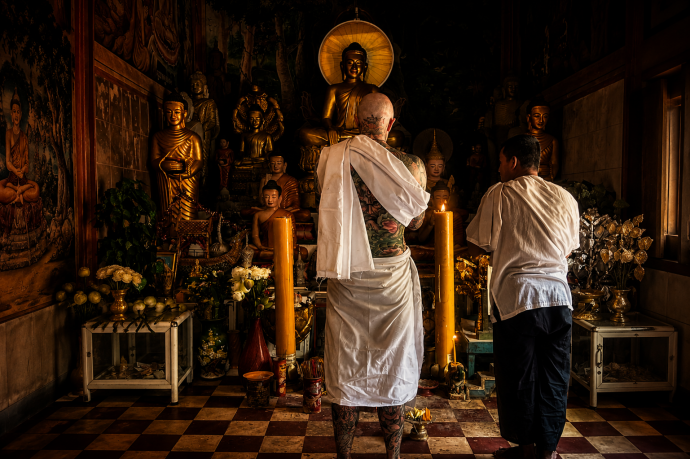
Can a Non-Buddhist Get a Sak Yant Tattoo?
One of the most common questions people ask me before a session is whether a non-Buddhist can get Sak Yant. I hear it especially often from Christians, Europeans, and people who are generally distant from religion but feel drawn to the tradition.
In my years of practicing Sak Yant tattooing, I have heard all sorts of opinions, myths, and worries about this. Some think only monks can get Sak Yant. Others are convinced these tattoos are forbidden to people of other faiths. Still others see them purely as beautiful designs with no spiritual meaning.
The answer is both deeper and simpler.
Sak Yant and Buddhism
The Sak Yant tradition is indeed closely tied to Buddhism. Most yants are based on ancient mantras and sacred texts in Pali, the language of early Buddhist scriptures.
Over time these texts were adapted to different Southeast Asian languages and scripts, including Khmer, Thai, Lanna, and other forms of sacred writing. This is why Sak Yant can look different across regions of Thailand and Cambodia.
It is important to understand that Sak Yant is a spiritual and cultural tradition that formed over centuries. It is not a religion in its own right.
In Thailand and Cambodia, you will find many people with yants who are neither monks nor particularly religious. Many get Sak Yant as a protective symbol or as a reminder of a personal journey, discipline, a stage of life, or a personal transformation.
This is not so different from people elsewhere getting tattoos of runes, ancient scripts, Latin phrases, or sacred signs tied to their culture and philosophy.
Can a Christian Get Sak Yant?
Yes, people of any religion can get Sak Yant. Over the years I have tattooed Sak Yant on Christians, including Catholics, people with no religious affiliation, and people interested in the cultures of Thailand and Cambodia.
There is one important point to consider.
If you have a spiritual adviser in your religion and follow their guidance, it is best to ask them beforehand how they view such tattoos.
Some advisers have discouraged people from wearing sacred writing from other religions or philosophies on their bodies. In those situations, many people choose Southeast Asian-style tattoo art solely for its appearance, leaving out mantras and sacred texts.
That is a perfectly valid approach, too.
If someone treats Sak Yant as nothing more than an exotic image, with no respect for the tradition, its meaning is lost. When there is understanding, respect for the culture, and a considered approach, there is generally no serious conflict.
Buddhism is generally not about aggressively imposing its beliefs. It is a philosophy of observation, inner work, and mindfulness. In Thailand and Cambodia, people are therefore fairly comfortable with foreigners, including Europeans, getting Sak Yant.
Sak Yant for Europeans
Sak Yant has long since spread beyond Thailand and Cambodia, and the tradition is known worldwide. People fly to Bangkok, Pattaya, Phnom Penh, and other cities specifically to receive a traditional yant.
Most foreigners do not speak Pali, read ancient scripts, or practice Buddhism. Their interest in Sak Yant can be every bit as sincere.
People very often come to a tattoo like this through personal reflection, changes or difficulties in their lives, or a desire to mark an important period.
That is completely normal.
Do You Have to Follow Buddhist Rules After Getting Sak Yant?
There are a great many myths about this, too.
Some practitioners and monks do offer certain recommendations after applying Sak Yant. They may concern behavior, how you treat other people, self-discipline, and your way of life.
These recommendations are neither a “magic contract” nor a required initiation into a religion.
They are more an attempt to guide a person toward living more mindfully.
In traditional Thai and Cambodian cultures, a yant's power is thought to be directly tied to the wearer's own behavior. People of other religions can still wear Sak Yant.
Why Is There So Much Mysticism Around Sak Yant?
It is a very old tradition. It has always been surrounded by many legends, stories, and exaggerations.
Some believe yants offer magical protection. Others regard them as a psychological anchor and a symbol of inner strength. Still others see them solely as a part of Thailand and Cambodia's cultural heritage.
Each is right in their own way.
In my experience, Sak Yant can indeed have a strong effect on a person's inner state, mainly through how they relate to themselves, their discipline, their intention, and their mindfulness.
A tattoo alone cannot change someone's life without their own involvement.
Sak Yant as a Considered Choice
I always tell people one simple thing: don't get Sak Yant just because it is fashionable.
Thai and Khmer sacred tattoos are very popular right now. Many people see photos online of beautiful geometric symbols, Buddhist elements, tigers, or mantras and want to reproduce them without understanding their meaning.
Authentic Sak Yant is ultimately about a feeling that resonates with you.
You do not have to be Buddhist, know every mantra, or read ancient texts. What matters is treating the tradition with respect.
My Perspective as a Sak Yant Practitioner
I have met many different people in my work with Sak Yant tattoos. In my experience, religion does not always determine how someone relates to the tradition.
Sometimes a person with no religious affiliation approaches Sak Yant more deeply and thoughtfully than someone who formally identifies as religious.
For me, genuine interest in Sak Yant begins with respect for the culture, an understanding of the symbols, and a thoughtful choice of design.
That is why before a session I always try to explain the meaning of the yants, where the symbols come from, and what distinguishes the tradition.
Conclusion
Can a non-Buddhist get Sak Yant? Yes.
People of different nationalities, cultures, and religions get Sak Yant all around the world. What matters is understanding that it is part of an ancient tradition with deep cultural and spiritual meaning, as well as a decorative tattoo.
Respect for that tradition is what makes Sak Yant a truly considered choice.