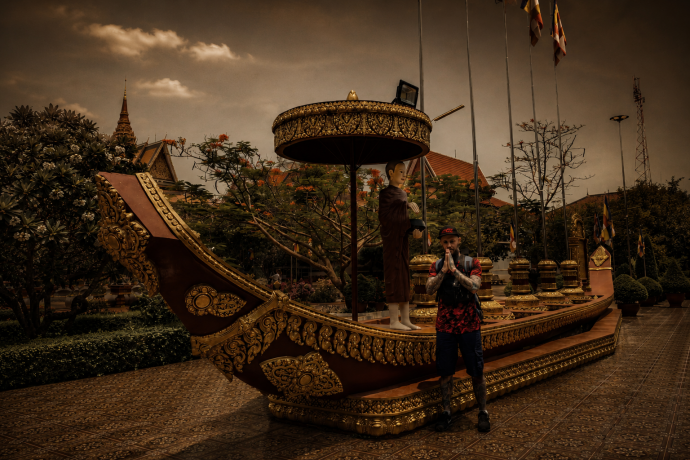
When people hear about Sak Yant, they most often think of Thailand. However, the tradition of sacred yantras exists within both Thai and Khmer traditions.
For many years, I have been interested in the distinctive execution of traditional Southeast Asian tattoos: their composition, structure, Pali script, the sound of mantric texts and methods of application.
Why I Went to Cambodia to Study Sak Yant
Working with and studying Sak Yant in Cambodia became an important stage in my professional journey.
My foundations, however, were initially formed in Thailand. I lived and worked there for about eight years, studying the Sak Yant tradition, the local interpretation of Pali script, and the pronunciation and reading of mantric texts.
While living and working in Thailand, it was quite difficult to arrange extended study with certain teachers. Nevertheless, it was during this period that I developed a general understanding of the Thai tradition, its approaches to constructing yantras, the sound of Pali, the reading of texts and the characteristics of their practical application.
Later, it became clear that a deeper understanding of the tradition required studying not only the modern Thai interpretation, but also earlier Khmer sources, which have preserved many old yantra forms, names and principles of composition.
What Distinguishes the Khmer Sak Yant Tradition?
Many contemporary designs now called Sak Yant are adapted versions of ancient Khmer and Thai yantras.
In Cambodia, one can find not only earlier versions of ornaments, texts and protective symbols, but also original designs that existed at the very beginning of the tradition and only later began to change, including within Thai practice.
Not all contemporary designs originally looked the way we are used to seeing them today. Some images, names and yantra forms changed gradually, year by year, alongside the development of schools, approaches and local traditions.
What Matters in the Khmer Tradition
- the construction of the composition;
- the writing of texts;
- the reading and sound of Pali;
- the placement of symbols on the body;
- the proportions and balance of the image;
- traditional methods of application;
- differences in script and pronunciation compared with the Thai tradition.
In previous articles, I have already discussed not only the script but also the designs in detail: what existed originally, what did not exist earlier, and which images appeared or changed later.
What My Experience in Cambodia Gave Me
Working and communicating with artists allowed me to see Sak Yant not simply as a collection of separate designs, but as an entire system of visual symbols, schools, approaches and local traditions.
The Sak Yant Federation of Cambodia includes a considerable number of studios and artists throughout the country. This meant that after every class and seminar, there were many opportunities to travel to different places, speak with artists, study their approaches to yantra, and compare their styles of execution and working methods.
What I Studied in Cambodia
- traditional yant forms;
- the characteristics of Khmer graphics;
- the construction of protective compositions;
- adapting traditional designs to the modern human body;
- the manual handpoke technique;
- local ways of reading and writing Pali texts;
- differences in the names and sounds of individual symbols.
All of this happened gradually, year by year. Each new trip revealed something new. However, one of the most difficult stages was essentially relearning Pali through Khmer pronunciation and script, which differ in many ways from the familiar Thai interpretation.
I still use this knowledge in my practice today. Moreover, I continue to return to the Sak Yant Federation of Cambodia every year to study the tradition further and in greater depth.
Sak Yant in Thailand and Cambodia: The Main Differences
Many people search for “Sak Yant Thailand,” “tattoo artist Thailand” or “Pattaya tattoo,” believing that the tradition exists only there. In practice, contemporary forms of Sak Yant developed under the influence of several Southeast Asian cultures.
The Thai tradition is known for designs such as Gao Yord, Suea Koo, Hanuman, Garuda, Paed Tidt and various forms of protective yantras. The Khmer tradition, meanwhile, has preserved many early forms, its own names and distinctive principles of composition.
Differences in Names and Sounds
Some names may sound different or have alternative pronunciations. For example:
- Rahu — Rihu;
- Singha — Sangha;
- and many other variants that differ from the familiar Thai interpretation.
The differences concern not only names, but also spelling, pronunciation, the structure of individual yantras and the construction of compositions. Some symbols may have different names, while some forms have no direct equivalent in the other tradition.
Why It Is Important to Choose a Specialist Sak Yant Artist
Today, many artists offer Sak Yant after only a brief introduction to the subject or tourist trips to Southeast Asia. Traditional work, however, requires a much deeper understanding.
What to Look For
- experience specifically with Sak Yant;
- an understanding of Thai and Khmer traditions;
- knowledge of yantra structure;
- an understanding of Pali script and pronunciation;
- the ability to adapt a traditional design to the body;
- experience with manual handpoke tattooing.
When choosing an artist, it is therefore important to consider not only a beautiful image, but also genuine experience specifically with the Sak Yant tradition.
Sak Yant in Moscow
Today, I work in Moscow and continue to develop my practice of traditional Southeast Asian tattooing.
If you would like to get Sak Yant in Moscow, have a consultation about choosing a symbol or learn more about traditional designs, we can always discuss the future work in advance.
Each project is chosen individually, taking into account the composition, anatomy, tradition and characteristics of the selected design.
Popular Areas of Work
- Sak Yant tattoo Moscow;
- Sak Yant artist Moscow;
- get Sak Yant in Moscow;
- Sak Yant Arbat;
- traditional Sak Yant Moscow;
- handpoke Moscow;
- Thai tattoo Moscow.
Summary
Sak Yant is more than a drawing: it is part of a broad cultural tradition that is important to understand and respect. For me, working in this field means continuous study, practice, travel, communication with artists and a gradual deepening of my understanding of Thai and Khmer traditions.