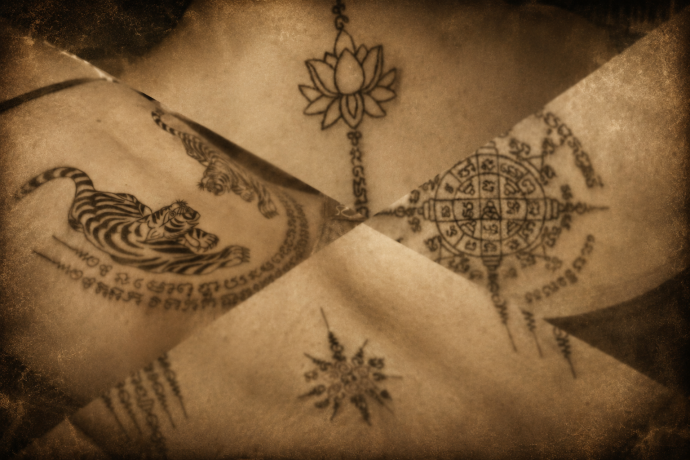
Khmer and Thai Sak Yant Traditions: Meaning, Designs and Differences
Sak Yant is an ancient sacred tattooing tradition from Southeast Asia, closely connected with Buddhist, animist and Khmer magical culture. Interest in this tradition is now growing around the world, and many people search for Sak Yant meanings and designs, trying to understand which symbol is right for them.
Yet the deeper you explore the subject, the sooner you realise that Sak Yant is more than a collection of beautiful images or popular symbols found online. Behind every yant is an entire system of sacred geometry, mantric formulas and traditions that developed differently in different countries.
It is especially important to understand the distinction between the Thai and Khmer Sak Yant traditions. Despite their shared roots, these are two different systems, with their own approaches to constructing symbols, naming them and understanding the philosophy of sacred tattooing itself.
Popular Sak Yant Designs and Their Meanings
Many people search for Sak Yant designs and meanings to understand which symbol suits them and what energy it carries. Online, however, they usually see only a limited selection of standard images: basic designs copied from one website to another. Many of these are far removed from the original tradition or have been greatly simplified.
In reality, Sak Yant designs do not work like a catalogue of ordinary tattoos from which you simply choose a ready-made image. In the tradition of sacred tattooing, the form and geometry matter, but so do a person's purpose, state of mind, direction in life and the structure of the symbol itself.
Basic images should therefore be seen more as a reference and a way to get a feel for the tradition's aesthetic: to understand which forms, lines and compositions speak to you. With that understanding, you can then go to a master, who creates an individual design for a particular person and purpose.
Yes, there are classic, broadly applicable yants that suit many people and serve as basic forms of protection. More often, however, people eventually want to create their own sacred design: an individual structure that cannot simply be found online. Only a master can create such a design, building it around the person's particular energy, path and intention.
Basic Sak Yant Designs
Ha Taew — Five Lines (Thai Tradition)
Ha Taew is one of the most recognisable and popular Sak Yant designs in the world. It is the yant that appears most often when people search for Sak Yant designs or want to get their first Sak Yant tattoo.
Online descriptions often assign a separate meaning to each of the five lines: protection, luck, charisma, success and so on. Within the tradition itself, however, everything is much deeper and more complex.
The mantric texts and sacred formulas within Ha Taew do not exist as entirely separate elements. They flow from one line to another, creating a single structure. The meaning is not divided into five independent parts: one formula continues into the next, gradually forming a shared flow of protection, strengthening and blessing.
Another point is important to understand: Ha Taew belongs specifically to the Thai Sak Yant tradition. In the classical Khmer tradition, the Five Lines were never a basic design and were essentially absent as a standalone canonical yant.
Linear Structures in the Khmer Tradition
- one line;
- three lines;
- four lines.
These forms are considered more characteristic of older Khmer sacred geometry. The modern Five Lines are therefore a development of the Thai school, rather than an original Khmer design.
Chat Phet — An Enhancement of the Five Lines (Thai Tradition)
Chat Phet is understood as a continuation and strengthening of Ha Taew. This design is often used as the next stage after the basic Five Lines, when a person wants to develop the sacred geometry on their back and strengthen the overall structure of their yants.
These Sak Yant designs are more often chosen by people who already know the tradition in greater depth and understand the meaning of sacred tattooing. For many, it becomes part of a larger composition gradually assembled over the years, rather than a separate tattoo.
In the Thai tradition, Chat Phet became known as a separate enhancing element, but its origins are closely connected with older Khmer geometric systems. Similar structures for strengthening and extending lines existed in the Khmer tradition, although the modern Thai names and visual forms have changed over time.
Gao Yord — Three, Five, Seven and Nine Spires
Gao Yord is considered one of the most important and recognisable yants in the Thai tradition. Its structure is built around sacred spires, recalling temple architecture and a sacred system of levels of protection.
Variations have three, five, seven or nine peaks, although the nine-spire version has become the best-known form.
- spiritual protection;
- inner discipline;
- increased status and strength;
- protection of the space around a person.
Gao Yord is considered one of the basic designs with which many people begin their journey into the Sak Yant tradition. This is why it is often placed on the upper back, at the head of the whole composition, as the central foundation for the further construction of a sacred structure.
Today both men and women choose this design, although historically it was more often used as a powerful protective yant for men.
Paed Tidt — Eight Directions (Thai Tradition)
Paed Tidt is one of the most complex protective yants in the Thai tradition. Its structure is built around the idea of protection in every direction and towards every point of the compass.
The forms of protection within the yant are believed to work regardless of where a person moves or which path they choose. This underlies the belief that the yant is particularly popular with people whose lives involve roads, travel, constant movement and the search for a new direction in life.
When people look for a Sak Yant tattoo design, Paed Tidt often attracts attention with its intricate symmetry and powerful geometry.
Directions in the Khmer Tradition
- ten directions;
- twelve directions;
- and other expanded geometric systems of protection.
Many familiar yant names actually developed within the Thai tradition and are directly connected with the Thai language. Names such as Ha Taew, Paed Tidt and Gao Yord form part of a Thai naming system that emerged as Thai Sak Yant schools developed.
Many original Khmer designs, meanwhile, did not initially have fixed names in the modern sense at all. The sacred geometry, mantric formulas and structure of the symbol were what mattered, rather than a separate name for it.
Differences Between Thai and Khmer Sak Yant Geometry
When you begin studying Sak Yant designs and meanings, you soon discover that designs which look similar can belong to entirely different traditions. The main difference lies not only in the shape of the yant itself, but also in the approach to constructing its sacred geometry.
Over time, the Thai Sak Yant tradition became more structured and visually recognisable. This is why most popular designs today have a fixed form, name and composition.
The Khmer tradition works differently. Its sacred geometry is more complex, living and varied. The same principle of protection can be expressed in dozens of different ways. There are fewer fixed templates and much greater attention to the structure of the magical formula itself, the placement of symbols and the interaction between elements.
This is why original Khmer yants often look less immediately understandable to someone accustomed to popular images online. They may have less visual symmetry, but much greater depth in the construction of the symbol itself.
Another important difference is how the overall composition is built on the body. In the Khmer system, yants are rarely seen as separate pictures. More often they form a single geometric structure that is gradually assembled on a person's body over the years.
Why Most Sak Yant Designs Online Are Simplified
Today, when people search for somewhere to get Sak Yant or choose a Sak Yant tattoo design, they almost always encounter the same images. The reason is simple: the internet has long since turned many sacred yants into a set of popular templates.
Most images found through searches are heavily simplified versions of the original designs. Complex elements are often removed, mantric texts shortened, and the proportions and geometric connections between symbols lost.
Why This Happens
First, genuine sacred structures are considerably more complex than their adapted online versions.
Second, many images online were created by ordinary tattoo studios adapting Sak Yant into a decorative style, rather than by masters of the tradition.
Third, some genuine Khmer and Thai designs are never published openly at all. Certain structures are passed down only within the tradition, from master to student.
This is why someone who truly wants to understand the Sak Yant tradition more deeply eventually turns away from looking for a ready-made image and towards working with a master.
Individual Sak Yant and Working with a Master
Today many people want a Sak Yant tattoo based solely on photographs found online. The authentic tradition, however, has always worked differently.
Sak Yant is more than a decorative tattoo. In the original system, the master not only tattoos the symbol but also helps construct the future yant's structure around the individual.
This is why an image search cannot yield a design that is entirely your own. The internet shows only basic forms, while real sacred geometry is assembled individually.
People often arrive with a sense of the aesthetic they connect with: lines, spires, directions, symmetry or more complex geometric structures. From that starting point, the master creates a composition suited to that particular person.
If you would like to explore the Sak Yant tradition in greater depth, understand the differences between the Thai and Khmer schools or create an individual sacred design, you can see more examples of the work at kolesniktattooart.com.