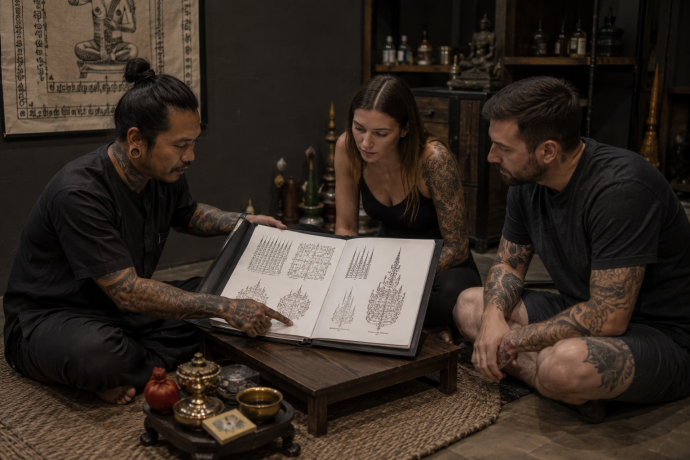
Sak Yant is more than a tattoo featuring Asian symbols. In the traditions of Thailand and Cambodia, sacred yants are considered spiritual protective signs that bring together Buddhist mantras, ancient geometry, symbols of strength and a person's individual intention.
Today, many people choose Sak Yant for its deep meaning as well as its aesthetics. One of the most frequently asked questions, however, remains the same:
“How do I choose a Sak Yant that is right for me?”
There is no universal answer. The same yant can reveal itself differently for different people. Within the tradition, much depends on a person's purpose, inner state, path in life and even character.
In this article, we will explore:
- how to choose Sak Yant by its meaning;
- which yants are considered protective;
- how popular symbols differ;
- whether you can choose a yant yourself;
- and why it is important to consult an artist who understands the tradition.
What Sak Yant Means
The words “Sak Yant” come from the Thai tradition. “Sak” means a tattoo or the process of tattooing, while “Yant” means a holy symbol, a yant or sacred geometry.
In the Cambodian and Khmer tradition, the pronunciation “Sak Yont” is more common — Sak Yont or Sak Yon.
Despite the differences in pronunciation, this is the same spiritual tradition of Southeast Asia associated with sacred symbols, mantras and protective geometry.
Traditional yants developed under the influence of:
- Buddhist philosophy;
- the Khmer mystical tradition;
- ancient protective mantras in Pali;
- sacred geometry;
- the astrological and spiritual practices of Southeast Asia.
Every yant combines:
- geometry;
- mantras;
- symbols;
- the direction of energy;
- a protective or strengthening meaning.
For some people, Sak Yant becomes a symbol of inner strength; for others, it represents spiritual protection, discipline, good fortune or a new stage in life.
Can You Choose Sak Yant Yourself?
Yes, but it is important to understand the difference between:
- choosing visually;
- and making a conscious choice based on meaning.
Many people choose a yant simply because it looks beautiful in a photograph. Within the tradition, however, it is believed that the symbol should resonate with the person.
An experienced artist usually pays attention to:
- the person's life situation;
- their character;
- their inner needs;
- their goals;
- their energy and state of mind;
- their attitude towards the practice and symbolism.
Sometimes a person arrives wanting one yant, but during the consultation it becomes clear that an entirely different symbol is closer to them.
How to Choose Sak Yant by Its Meaning
Sak Yant for Protection
Some of the most popular yants are associated with protection.
These symbols are chosen by people who:
- are going through a difficult period in life;
- want inner stability;
- travel frequently;
- work with large numbers of people;
- feel emotional pressure or stress.
Yants often considered protective include:
- Gao Yord;
- Hah Taew;
- Paed Tidt;
- Diamond Crown (Mokot Pyt);
- various forms of unalomes and mantras.
It is important to understand that this article mentions only some of the most popular and classical options. In practice, an artist can always show you other yants and explain them, their combinations and individual variations in detail.
These symbols are believed to help maintain inner balance, concentration and resilience.
Sak Yant for Good Fortune and Success
Some yants are traditionally associated with:
- attracting opportunities;
- career advancement;
- charisma;
- confidence;
- financial flow;
- social recognition.
These yants are especially popular among:
- entrepreneurs;
- performers;
- public figures;
- people working in creative professions.
Within the tradition, however, the yant itself is believed not to “do everything for a person”, but to strengthen their intention, discipline and inner direction.
Sak Yant for an Inner Journey
Some yants are chosen as symbols of personal transformation rather than for external goals.
They may be associated with:
- finding yourself;
- spiritual development;
- overcoming the past;
- a new chapter in life;
- inner peace.
These designs often feature:
- unalomes;
- mantras;
- minimalist geometric forms;
- ancient Khmer symbols.
Popular Sak Yants and Their Meanings
Gao Yord — Nine Peaks
One of the best-known Sak Yants.
It is considered a symbol of:
- supreme protection;
- spiritual strength;
- authority;
- stability.
It is often placed on the upper back.
The geometry of the yant symbolises nine sacred peaks and protection in different directions.
Hah Taew — Five Lines
One of the most recognisable yants in the world.
Each line contains a separate mantra and is associated with a particular aspect:
- protection;
- good fortune;
- charisma;
- energy;
- favourable changes.
This yant is often chosen as a first tattoo.
Paed Tidt — Eight Directions
A complex protective yant associated with the eight compass directions.
It symbolises:
- movement;
- protection while travelling;
- balance;
- stability;
- control over the direction of one's life.
Diamond Crown — The Diamond Crown (Mokot Pyt)
Diamond Crown is one of the well-known Khmer yants, originally called “Mokot Pyt”.
The symbol is associated with:
- inner strength;
- concentration;
- spiritual protection;
- clarity of intention;
- stability.
The composition often incorporates elements of sacred geometry, crowns and Khmer symbolism.
Unalome
The unalome is one of the most ancient symbols in the Buddhist tradition.
It is associated with:
- one's path in life;
- overcoming chaos;
- spiritual growth;
- moving towards clarity.
It is often used as a standalone symbol or as part of a more complex yant.
How to Understand Which Sak Yant Is Right for You
1. Through Your Needs in Life
This is the most common approach.
You need to answer honestly:
- what you are currently lacking;
- what you would like to strengthen;
- which stage of life you are going through;
- why you want Sak Yant.
For example:
- protection;
- confidence;
- inner balance;
- discipline;
- good fortune;
- a new stage in life.
2. Through Your Visual Response
Sometimes a person does not yet know a symbol's meaning, but a particular yant evokes a strong inner response.
Within the tradition, this is also considered important.
Afterwards, however, it is advisable to study the symbol's meaning and consult an artist.
3. Through a Consultation with the Artist
An experienced Sak Yant artist helps you choose a symbol for its meaning as well as its appearance.
A consultation usually covers:
- the meaning of the yant;
- placement;
- size;
- combinations of symbols;
- traditional restrictions;
- the particular features of its application.
This is precisely why it is important to consult someone who understands the symbolism and tradition, rather than simply any tattoo artist.
Does Placement Matter?
Yes.
Within the tradition, the placement of Sak Yant has significance.
Some yants are applied:
- only above the waist;
- only on the back;
- to central energy zones;
- in a particular sequence.
For example:
- protective yants are often placed on the back;
- unalomes along the central axis;
- small mantras on the arms or chest.
Along with aesthetics, the symbolic direction of energy is taken into account.
Mistakes When Choosing Sak Yant
Choosing Solely from a Picture
The most common mistake.
A visually beautiful yant may not match your needs, or may have an entirely different meaning.
Copying Random Images from the Internet
There are an enormous number of mistakes online:
- mixed-up mantras;
- distorted symbols;
- incorrect geometry;
- random collections of characters.
Some images have no connection with traditional Sak Yant at all.
Choosing an Artist Who Does Not Understand the Tradition
Sak Yant is a distinct field.
It is important that the artist understands:
- the structure of the yant;
- the meanings of the symbols;
- traditional placement;
- the particular features of the mantras;
- the cultural context.
Do You Need to Believe in Sak Yant?
Everyone has their own attitude towards this.
For some, it is:
- a spiritual practice;
- a symbol of their path;
- a personal talisman;
- an aesthetic;
- part of Southeast Asian culture.
Even within the tradition itself, much rests not only on the symbol, but also on:
- the person's intention;
- inner discipline;
- their attitude towards their own path.
How Sak Yant Is Selected
The process usually looks like this:
- Discussing the idea and your needs.
- Choosing a yant by its meaning.
- Discussing placement.
- Adapting the composition to the body.
- Preparing the design.
- Tattooing.
Sometimes choosing a yant takes longer than the tattooing itself — especially when a person wants a truly considered symbol.
A Sak Yant Artist in Moscow
If you want to choose Sak Yant consciously, it is important to consult an artist who works with more than the visual aspect and also understands the traditional symbolism.
A consultation helps you:
- understand the meanings;
- choose an appropriate yant;
- avoid mistakes;
- create an individual composition;
- choose the correct placement.
Sak Yant is more than a design on the skin. For many people, it is a symbol of an inner stage, an intention and a personal path.
Conclusion
Choosing Sak Yant is always an individual process.
Some people feel closer to protective yants, while others prefer symbols of inner growth, good fortune or a path in life.
The main thing is not to choose a symbol at random.
A good Sak Yant combines:
- meaning;
- a personal response;
- a well-designed composition;
- an understanding of the tradition.
That is why it is important to study the meanings of the symbols and discuss your choice with the artist before getting tattooed.
```