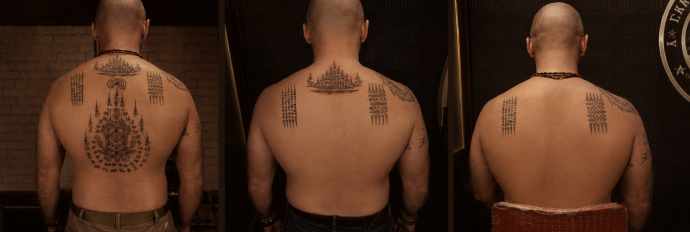
How to Correct a Sak Yant Tattoo with Mistakes
A Sak Yant tattoo with mistakes is more than an unsuccessful tattoo. These designs depend not only on lines, symmetry and neat execution, but also on structure, legible symbols, text placement, meaning, the accuracy of the mantra and the underlying logic of the design.
Very often, someone comes to me after their tattoo has already been copied from an online image, without an understanding of the mantra, with incorrect geometry or with text transferred unevenly. Sometimes the tattoo contains a mistake in the mantra, an abbreviation, missing vowels in the Pali writing, or simply a collection of Pali alphabet characters without coherent meaning or structure.
At first glance, such a tattoo may resemble Sak Yant. A closer examination, however, reveals illegible symbols, disrupted lines and a composition that does not hold together. An ordinary touch-up is not always enough to correct it.
The good news is that some mistakes really can be corrected. The bad news is that not every incorrectly made Sak Yant can be saved with a touch-up alone, without a cover-up, laser treatment or partial removal of the old tattoo.
How to Tell Whether a Sak Yant Contains Mistakes
Several signs can indicate that a tattoo needs touching up, extending, covering up or completely reworking.
Illegible Symbols
One of the most common problems is that the symbols look like random lines. This happens when an artist simply copies an image without understanding what they are tattooing.
Visual resemblance alone is not enough in Sak Yant. If the symbols are too compressed, distorted or applied carelessly, they become difficult to read. As a result, the tattoo can look messy as soon as it has healed.
Uneven Text
Uneven text is particularly noticeable in Sak Yant because many designs rely on rhythm, repetition and precise geometry. Even a small shift can spoil the whole tattoo.
Sometimes the problem is more than uneven rows. The text may wander, the letters may vary in size, the spacing between symbols may be arbitrary and the overall form may look uncertain.
A Mistake in the Mantra
This is one of the most serious errors. Symbols may be missing from the mantra, important parts may have been shortened, elements mixed up or the structure of the text itself disrupted.
Another common mistake is for an artist to tattoo a collection of Pali alphabet characters instead of a mantra. It may look like sacred writing, but the tattoo may not convey the meaning the person expected.
Missing Vowels in Pali Writing
Missing vowels in Pali writing are another common problem. Someone unfamiliar with the subject may not notice them, but such an error matters to the correct structure of a Sak Yant.
In this situation, the first step is to establish what has actually been tattooed, whether it has a legible structure and whether it can be carefully put right. Sometimes only part can be corrected. In difficult cases, part of the old tattoo must first be removed or lightened, and the area can only be rebuilt with a new design after some time has passed.
Poor Geometry
Sak Yant often relies on symmetry: lines, a central axis, spacing and balance on the body. If the geometry is disrupted, the tattoo looks crooked even when the lines themselves are reasonably well executed.
This is especially noticeable on the back, chest and neck, between the shoulder blades and along the spine. If the tattoo was poorly positioned on the body from the outset, correcting it becomes more difficult.
When the Design Can Be Extended
One way to correct a tattoo is to extend the design rather than simply cover up the old work. Additional elements, new designs and a well-planned composition can bring the overall geometry as close as possible to the intended form, provided the existing tattoo allows it.
A Copy from the Internet
Many Sak Yant tattoos with mistakes begin when someone brings an artist an image from a search engine, Pinterest or another person's tattoo. The artist transfers it as an ordinary ornament without checking its meaning or structure.
The problem is that distorted copies are already widespread online. Each further copy becomes worse: details disappear, lines merge and symbols turn into decorative strokes.
An Artist Who Does Not Understand the Meaning
If an artist does not work with Sak Yant or understand how these designs are constructed, they may be technically capable of tattooing one but make mistakes in the most important aspects: structure, symbols, composition, placement on the body and writing.
A common mistake is to obscure individual symbols, simplify the text, omit vowels in the Pali writing or replace the mantra with a decorative collection of signs. It may look like Sak Yant to the client, but the work is in fact incorrect.
Sak Yant should not be treated as an ordinary pattern. It is important to understand where a touch-up is possible, where the design needs extending, where careless intervention must be avoided and where a cover-up or preliminary laser lightening is the better option from the outset.
Which Sak Yant Mistakes Can Be Corrected?
Not every mistake requires a complete cover-up. Sometimes a careful touch-up can make a tattoo look cleaner.
Uneven Lines
If the lines are slightly uneven but the structure remains legible, they can be straightened. The important thing is not to make the tattoo excessively thick.
A poor touch-up often makes the work worse: the artist tries to hide unevenness with a thick line, leaving the Sak Yant looking coarse, heavy and less legible.
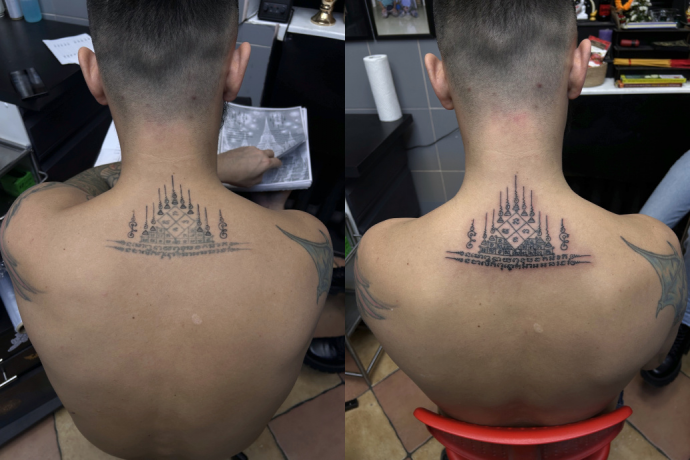
Poor Legibility
If the symbols are partly legible but look faint or hesitant, contrast can be increased, individual areas restored and the work made neater.
This involves more than simply going over the old lines. It requires an understanding of which elements can be reinforced and which are best left alone, so that the text does not become a black patch.
Loss of Detail After Healing
Fine elements can become lighter after healing, and some details may fall out, particularly if the tattoo was applied too superficially or the skin did not retain the pigment well.
Such cases can often be corrected with a touch-up. First, however, it is important to assess how cleanly the tattoo has healed and whether the small symbols have blurred.
Minor Technical Errors
Minor technical errors include small gaps, faint areas, uneven density and individual inaccurate lines.
If the foundation is sound, these mistakes can be corrected without a cover-up. But if the problem lies in the text itself, the mantra or the composition, a technical touch-up will not fully save the tattoo.
Composing Around the Old Tattoo
Sometimes an old Sak Yant cannot be fully corrected, but it can be thoughtfully incorporated into a new composition. For example, surrounding elements can be added, the visual balance adjusted, the central section strengthened or a new design created to make the old work look neater.
This is a good option when someone does not want a complete cover-up but wants the tattoo to look stronger and more cohesive.
Extending the Design
Another way to correct a tattoo is to extend the design around the old work. This suits cases in which the original Sak Yant cannot be made perfect but can be incorporated into a better-structured composition.
Other designs, additional elements, symmetry and appropriate placement on the body can visually unite the tattoo into a more cohesive project. This is not always possible, however. It depends on how dense, crooked and dark the old tattoo is and where it is located.
What Is Difficult or Impossible to Correct?
Some mistakes cannot honestly be corrected with a single touch-up. In these cases, it is better to tell the truth from the start than promise the impossible.
Completely Incorrect Text
If the text was tattooed incorrectly from the outset, with mixed-up symbols or a mantra that is abbreviated, obscured or lacks a coherent structure, a simple touch-up will not solve the problem.
The tattoo can be made visually neater, but that does not mean it will become a correctly constructed Sak Yant. Sometimes the only honest option is a cover-up or preliminary laser lightening.
Alphabet Characters Instead of a Mantra
Sometimes a tattoo contains a collection of letters or symbols from the Pali alphabet rather than a mantra. It may visually resemble Sak Yant, but it does not function as a coherent text in terms of meaning.
An ordinary line touch-up cannot correct this mistake. The structure must be examined again to decide whether the old tattoo can be incorporated into a new project, covered up or partially lightened first.
Symbols That Are Too Small
If symbols are tattooed too small, they may merge over time. This is particularly true of closely spaced rows, fine text and areas where the skin moves a great deal.
Correcting excessively small symbols is difficult because reinforcing any line makes them even denser. The result can be a dark mass instead of readable text.
Overly Dense Black Ink
If the old Sak Yant is already heavily saturated with black, there are fewer options. A correct version cannot simply be drawn over a dense black tattoo.
Laser treatment is often needed in these cases. Sometimes part of the old tattoo must first be removed or lightened and the skin allowed to recover. Only after some time can the artist return to that area and rebuild it with a new design.
Poor Placement on the Body
If the tattoo was poorly placed from the outset—too high, too low, shifted to one side or without regard to anatomy—correcting it becomes difficult.
The visual balance can be improved, the composition extended around the old work or other elements used to partly realign the overall design. But the placement of an existing tattoo cannot be completely changed without a cover-up or laser treatment.
A Tattoo Without a Correct Structure
Sometimes a tattoo only resembles Sak Yant on the surface, without a coherent internal structure: random rows, random symbols, incorrect proportions, an unclear centre of composition, a mistake in the mantra or merely a decorative collection of signs.
Such a tattoo cannot simply be touched up. What to do with it must be reconsidered: touch it up, extend it, cover it up or lighten it first.
A Touch-Up, an Extended Design, a Cover-Up or Laser Treatment?
There are several main ways to correct a Sak Yant tattoo with mistakes.
A Touch-Up
A touch-up is suitable when the old tattoo is generally sound but has technical errors: faint lines, slight unevenness, lost details or uneven colour.
In this case, the aim is to preserve the foundation and make it neater.
Extending the Design
Extending the design is suitable when the old work cannot be fully corrected but can be incorporated into a larger, better-structured project.
For example, new elements can be added, symmetry established, the composition strengthened and the visual centre adjusted. Other designs can help bring the overall work as close as possible to the intended geometry.
This option works only when the existing tattoo allows it. If it is too dense, dark or poorly placed, laser treatment or a cover-up may be needed.
A Cover-Up
A cover-up is needed when the old Sak Yant is too distorted, crooked or structurally incoherent. The new design should do more than conceal the old tattoo: it should work thoughtfully with its shape, density and placement.
A good cover-up is always more difficult than an ordinary new tattoo because the artist is working with existing limitations rather than bare skin.
Laser Treatment
Laser treatment is needed when the tattoo is too dark or dense, or placed in a way that makes an attractive cover-up impossible without lightening it first.
Sometimes a few lightening sessions are enough to make it possible to create a cleaner, lighter and more accurately constructed Sak Yant afterwards. In some cases, only the specific area preventing correction needs lightening, rather than the whole tattoo. Once the skin has recovered, that section can be covered up or rebuilt with a new design.
Why Correcting a Tattoo Is Harder Than Creating a New One
A new Sak Yant can be constructed correctly from the outset, with its size, placement, structure, line weight and composition chosen to suit the body.
Correction is more complicated. The old tattoo already exists, along with its mistakes, density, unevenness, healing, placement and limitations imposed by the skin. The artist cannot simply erase inaccurate lines and start again.
Correction therefore requires more experience. The artist needs to see what can be saved, what is best left untouched, where to reinforce the work, where to extend the design, where to cover it up and where to say honestly that laser treatment is needed first.
The biggest mistake is trying to correct every flawed Sak Yant with a single touch-up. Sometimes this only makes the result worse.
What to Send the Artist for an Assessment
One photo is often not enough to establish whether a Sak Yant can be corrected. It is better to send several things straight away.
A Close-Up Photo of the Tattoo
A clear, unfiltered photo is needed so that the lines, symbols, ink density and condition of the skin can be seen.
A Photo Taken from Further Away
A photo from further away shows how the tattoo sits on the body: whether it is straight, whether the composition is shifted and whether the size is appropriate.
The Reference Used for the Tattoo
If the tattoo was copied from an image, it is important to send that reference. This helps establish where the mistake occurred: in the original image itself or when it was transferred to the skin.
When the Tattoo Was Made
A fresh tattoo and a fully healed tattoo are assessed differently. If the tattoo was made recently, it may be necessary to wait until it has fully healed before deciding on a touch-up.
What Exactly You Dislike
It is important to explain what concerns you: unevenness, symbols, meaning, legibility, placement, size, patches, poor healing, a mistake in the mantra or a general feeling that the Sak Yant has been made incorrectly.
What You Want: Correction, an Extended Design, a Cover-Up or an Explanation of the Meaning
Sometimes a person does not yet know exactly what needs to be done. That is normal. The first step can be to establish what has been tattooed, how much can be corrected and which option is more appropriate: a touch-up, an extended design, a cover-up or laser treatment.
Can a Sak Yant Tattoo with Mistakes Be Corrected?
Yes, a Sak Yant tattoo with mistakes can sometimes be corrected. But not always in the way you might initially hope.
If the problem is technical—lines, legibility or individual details—a careful touch-up often helps. If the mistake involves the text, mantra, structure or placement on the body, the design may need extending, covering up or partially lightening with a laser. If the tattoo is too dark and dense, it is better to lighten it first and only then restore or cover up the relevant area.
The most important thing is not to make the tattoo worse with another unsuccessful touch-up. Before attempting a correction, the old work must be examined carefully and the right approach chosen.
Send a photo of your tattoo, and I will assess whether it can be touched up, extended or covered up, or whether laser lightening would be the better first step.
```