How Traditional Sak Yant Differs from Machine Tattooing
One of the most common questions among people interested in Sak Yant is whether the design can be applied with an ordinary tattoo machine and whether it would still be considered genuine Sak Yant.
The answer depends on what a person means by Sak Yant. For some, only the appearance of the image matters. For others, the process of application itself, the artist's technique and the connection with the Thai and Khmer traditions are important.
How Traditional Sak Yant Is Applied
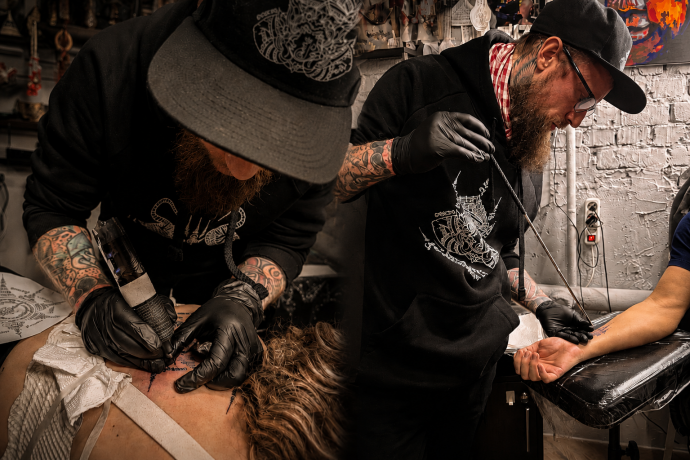
Traditionally, Sak Yant is applied with a long metal rod known in Thailand as Khem Sak. This technique has existed for many centuries and is still used today.
During the process, the artist manually introduces pigment into the skin with a series of quick, precise puncturing movements. Each line is formed by individual punctures rather than the continuous movement of a needle as in a modern machine.
This method is often compared with the handpoke technique. Traditional Sak Yant, however, has its own tools, distinctive hand positioning and working methods developed within the Thai and Khmer traditions.
In the Thai tradition, the artist most often works with an assistant who helps stretch the skin. This allows the work to be completed faster and the lines to be highly precise. In the Khmer tradition, the artist usually works independently, without an assistant.
Can Sak Yant Be Applied with a Machine?
Yes, technically any yant can be transferred to the skin using a modern tattoo machine. Many artists around the world work this way.
The result is an image that looks similar to traditional Sak Yant. The symbols, geometry and texts can be reproduced with virtually no changes.
The process of application itself, however, will differ from the classical technique.
Handpoke vs Tattoo Machine: The Main Differences
Speed of Work
A tattoo machine allows large pieces to be completed considerably faster. This is especially noticeable with large compositions containing many lines and details.
The machine technique is also well suited to small designs, minimalist work and projects requiring the greatest possible detail in individual elements.
Traditional Sak Yant requires more time and attention to every part of the design.
Sensations During the Session
Many people say that the manual technique feels different. The characteristic vibration of a machine is absent, and the action on the skin is more localised.
The level of discomfort is always individual, however, and depends on the placement, size of the piece and the characteristics of the person's body.
The Character of the Lines
A modern machine creates highly even, uniform lines thanks to the steady frequency of the needle's movement.
In traditional Sak Yant, small characteristics of handwork can be seen, which many enthusiasts consider part of the authentic character of this kind of tattoo.
Tradition and Process
The main difference lies not in the design, but in the method by which it is created.
If a person values the traditional tattooing technique, handwork and an experience as close as possible to the classical Sak Yant process, application with a metal rod is usually chosen.
If the priority is high precision, detailed treatment of small elements, minimalism or a more aesthetically refined modern appearance, the machine technique can be used.
What to Choose: Traditional Sak Yant or a Machine?
It cannot be said that one option is objectively better than the other. They are different approaches to tattooing.
Traditional Sak Yant is chosen by people interested in the technique itself, its history and the cultural component of the process.
The machine technique is more often chosen by those who value the greatest possible detail, clear lines, minimalist designs or particular artistic goals.
The most important thing is to consult an artist who understands the meaning of the symbols used, knows the structure of yants and can work competently with traditional images.
Conclusion
It is important to understand that machine-applied Sak Yant and traditional Sak Yant are not “correct” and “incorrect” alternatives. They are different techniques for applying the same image.
The difference lies primarily in the artist's working process, the tools used and the visual characteristics of the finished work.
The traditional method involves handwork with a metal rod and maintains a connection with the Thai and Khmer traditions. The machine technique offers more possibilities for fine detail, precise lines and contemporary artistic approaches.
The choice depends on what matters more to you: the traditional tattooing process or particular aesthetic goals for your future tattoo.